
Learning and Development: How Video Transforms Workforce Training
by Ali Rind, Last updated: April 6, 2026, ref:

Learning and development (L&D) is the structured process of building employee skills, knowledge, and competencies through training programs, mentoring, and continuous education. For organizations with hundreds or thousands of employees spread across offices, factories, and remote locations, delivering consistent L&D at scale is one of the hardest operational problems to solve well.
The gap between what L&D teams want to achieve and what they actually deliver keeps growing. According to the LinkedIn Workplace Learning Report 2024, 90% of organizations are concerned about employee retention, and providing learning opportunities is the number one strategy they are using to address it. Yet most training programs still rely on slide decks, PDFs, and occasional in-person workshops that employees forget within weeks.
Video has changed this equation. When employees can watch, pause, rewatch, and interact with training content on their own schedule, completion rates climb and knowledge actually sticks. But dropping a few recordings into a shared drive is not a strategy. Building an effective video-based L&D program requires the right structure, tools, and measurement framework.
Key Takeaways
- Video-based L&D programs improve knowledge retention by up to 65% compared to text-only training, according to research from the Association for Talent Development.
- Effective learning and development requires structured learning paths, interactive assessments, and completion tracking, not just a library of recorded content.
- SCORM and LTI integration lets video training platforms work alongside existing LMS investments rather than replacing them.
- Organizations with distributed or multilingual workforces need AI-powered transcription and adaptive delivery to reach every learner consistently.
- Measuring L&D success means tracking engagement at the video level (heat maps, rewatch rates) alongside quiz scores and certification completion.
What Is Learning and Development in the Workplace?
Learning and development encompasses every formal and informal effort an organization makes to improve employee capabilities. This includes onboarding programs for new hires, compliance training mandated by regulations, leadership development for high-potential employees, and technical skills training for specific roles.
L&D differs from one-time training events in a critical way: it is continuous. A strong L&D program creates ongoing pathways for employees to grow, not just checkboxes to clear during their first week. According to the Association for Talent Development's 2024 State of the Industry report, organizations spend an average of $1,283 per employee annually on learning, yet many struggle to measure whether that investment produces real skill improvement.
The core components of any L&D program include needs assessment, content creation, delivery, engagement, and measurement. Where most programs break down is in the last three. Content gets created but sits unused. Delivery is inconsistent across locations. And measurement, if it exists at all, tracks completion rather than comprehension.
Why Does Video Outperform Traditional Training Methods?
The human brain is wired for visual learning. Research from McKinsey's organizational performance practice shows that multimodal instruction, which combines visuals, narration, and demonstration, consistently outperforms text-only training in both comprehension and long-term recall. That is not an abstract finding. It has real implications for how adults learn and retain workplace skills.
Consider the difference between reading a ten-page safety manual and watching a three-minute video showing the actual procedures. The video communicates tone, demonstrates physical actions, and provides visual context that text simply cannot replicate. For complex procedures like equipment maintenance, software workflows, or patient care protocols, video closes the gap between knowing and doing.
Video also solves the scheduling problem. In-person training requires everyone to be in the same place at the same time. For organizations with multiple locations, shift workers, or remote employees, that is expensive and often impossible. On-demand video lets employees train when it fits their schedule, pause and resume as needed, and rewatch sections they did not fully grasp the first time.
The Retention Advantage
Research on the Ebbinghaus forgetting curve shows that learners forget roughly 70% of new information within 24 hours without reinforcement. Video-based microlearning combats this by breaking content into short, focused segments of three to seven minutes, making it easy for employees to revisit specific topics whenever they need a refresher.
Interactive video takes retention further. When learners answer quiz questions embedded within the video itself, they engage in active recall. That act of retrieving information strengthens memory formation far more than passive watching. Studies in cognitive science consistently show that testing during learning, not just after, improves long-term retention by 25% to 65%.
What Should a Video-Based L&D Program Include?
Structured Learning Paths
Learners should not have to figure out what to watch next. Effective programs organize content into sequenced paths where each module builds on the last. Prerequisites ensure that employees master foundational topics before advancing. A new hire onboarding path, for example, might require completing the company culture module before moving to role-specific technical training. The EnterpriseTube training and learning platform supports exactly this model, letting administrators build prerequisite-enforced learning plans directly within the platform.
Interactive Assessments
Quizzes, surveys, and knowledge checks embedded directly within video content serve two purposes. They test comprehension in real time, and they keep learners engaged. A ten-minute video with no interaction is easy to play in a background tab. A video that pauses to ask a question every few minutes demands active participation.
Completion Tracking and Certification
For compliance-driven industries like healthcare, financial services, energy, and government, proving that employees completed training is not optional. L&D platforms need to track who watched what, when they completed it, and what scores they earned on assessments. Automated certificate issuance eliminates manual paperwork and gives employees a tangible record of their progress.
LMS Integration
Most large organizations already have a Learning Management System (LMS). The video training platform should not replace it; it should work alongside it. Standards like SCORM 1.2/2004 and LTI 1.3 allow video platforms to pass quiz scores, completion data, and learner activity back to the LMS. As covered in detail in this guide on enhancing video-based learning without replacing your LMS, the right approach protects your existing LMS investment while adding purpose-built video infrastructure on top of it.
Accessibility and Multilingual Support
Training content that is only available in one language or lacks captions excludes a significant portion of the workforce. Effective L&D programs include closed captions, transcripts, and translations. For global organizations, AI-powered transcription can generate captions in dozens of languages, making a single training video accessible to teams worldwide.
How Do You Measure Learning and Development Effectiveness?
Completion rates alone do not tell you whether training works. They tell you whether people clicked "play." Measuring L&D effectiveness requires a layered approach that tracks engagement, comprehension, and application.
Engagement Analytics
Video heat maps reveal exactly how learners interact with content. They show which sections get rewatched (a sign of complexity or confusion), where viewers drop off (a sign the content lost relevance), and how long people actually spend watching versus skipping. These signals help L&D teams identify which content works and which needs rework.
Assessment Scores
In-video quiz results provide immediate, granular insight into comprehension. If 80% of learners miss the same question, the training content for that topic needs improvement. Aggregate quiz data across departments or locations reveals where specific teams may need additional support or coaching.
Kirkpatrick's Four Levels
The Kirkpatrick Model is the industry-standard framework for evaluating training at four levels: reaction (did learners like it?), learning (did they absorb it?), behavior (did they apply it?), and results (did it impact the business?). Video analytics address levels one and two directly. Linking L&D data with performance metrics like sales numbers, error rates, and safety incidents extends measurement into levels three and four.
Per-User Activity Tracking
For compliance and audit purposes, organizations need to prove that specific individuals completed specific training by specific dates. Exportable reports showing per-user viewing history, quiz attempts, scores, and certification dates satisfy audit requirements across regulated industries. For financial services firms in particular, this kind of audit-grade evidence is non-negotiable. See how video-based compliance training for financial advisors handles these requirements in practice.
What Challenges Do Distributed Teams Face with L&D?
Organizations with employees spread across multiple offices, field sites, or countries face unique learning and development obstacles that centralized companies do not encounter.
Bandwidth limitations at remote sites cause buffering, failed downloads, and poor video quality. An employee at an offshore oil platform or a rural corrections facility cannot rely on the same internet speeds as headquarters. Enterprise Content Delivery Networks (eCDN) solve this by distributing video across local nodes rather than pulling every stream from a central server.
Time zone differences make live training impractical for global teams. Recording live sessions for on-demand viewing solves the scheduling problem, but only if the platform supports easy search, chaptering, and navigation. Learners need to find relevant content quickly without watching hours of unrelated material.
Language barriers limit the reach of training content created at headquarters. A safety training video recorded in English will not help a team member in Saudi Arabia or Brazil unless it includes translated captions or audio tracks.
AI-powered transcription that supports dozens of languages can transform a single recording into globally accessible training content. Healthcare organizations face this challenge acutely. A healthcare video platform must account for role diversity and language access simultaneously to keep training effective and equitable across clinical teams.
How EnterpriseTube Powers Video-Based Learning and Development
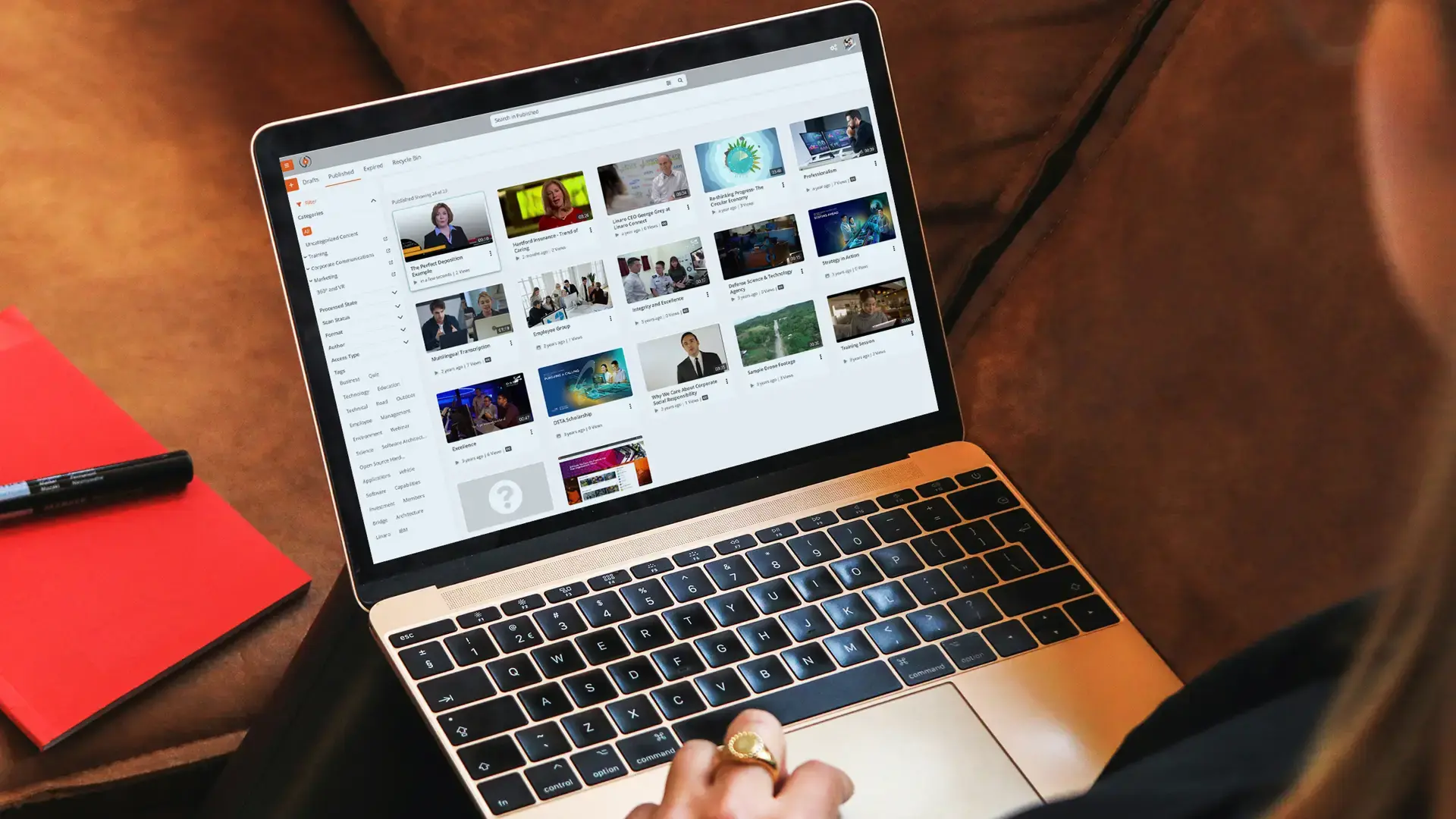
VIDIZMO EnterpriseTube combines video management, interactive learning tools, and enterprise delivery infrastructure in one platform built for L&D at scale.
Administrators can build sequenced training paths with prerequisite enforcement, keeping employees on the right track from onboarding through advanced role-specific content. In-video quizzes, surveys, and downloadable handouts reinforce learning, while automated certification ties certificates directly to quiz scores and completion milestones.
For organizations with existing LMS investments, EnterpriseTube integrates through SCORM 1.2/2004 and LTI 1.3, passing quiz scores, completion data, and learner activity back to platforms like Canvas, Moodle, and Blackboard. It serves as the video layer, not a replacement for the LMS itself.
AI-powered transcription and translation in 82 languages means a single English-recorded video can be automatically captioned in Arabic, Portuguese, Mandarin, or dozens of other languages. For remote and bandwidth-constrained sites, the platform's enterprise CDN ensures smooth playback even where internet connectivity is limited.
Ready to see how video can transform your organization's learning and development program? Contact EnterpriseTube sales to discuss your training goals and explore a platform built for enterprise-scale L&D.
Real-World L&D Programs Built on Video
Several organizations have built training programs that show what's possible with the right platform and approach.
Campari Academy trains over 3,000 external bartenders and internal sales staff using SCORM-compatible video courses, live streaming sessions with real-time chat, and automated certificate issuance. They even implemented custom age-gate verification for content access, showing how L&D can be tailored to industry-specific requirements.
Kings Clean, a school cleaning services provider, needed bilingual training for janitorial staff in both English and Spanish. They replaced two separate systems with a single video platform, added in-video quizzes to verify comprehension, and automated certificate generation for compliance tracking.
KAPSARC (King Abdullah Petroleum Studies and Research Center) delivers training across 20 affiliated entities using access-controlled portals with Arabic and multilingual transcription. In-video quizzes, digital handouts, and granular analytics give their L&D team visibility into engagement across every entity.
John Cockerill, a global engineering company, uses virtual maintenance tutorials and compliance safety training with in-video quizzes that produce measurable learning outcomes. Their multi-portal architecture lets different divisions maintain separate training libraries while sharing a single platform.
Building an L&D Content Strategy That Scales
Technology matters, but so does the content strategy behind it. These principles help L&D programs scale without sacrificing quality.
Start with Microlearning
Short, focused video modules of three to seven minutes each are easier to produce, easier to update, and easier for employees to fit into their day. Passion Restaurant Group onboards new staff using videos as short as 30 to 40 seconds, proving that effective training doesn't need to be long.
Use Data to Iterate
Video heat maps and quiz scores aren't just reports to file. They're feedback loops. If a safety training module shows a 40% drop-off rate at the three-minute mark, that section needs to be shorter, more visual, or restructured. Crystorama used analytics to identify specific training gaps in their sales team and adjusted their content accordingly.
Build Once, Deliver Everywhere
A single training video should be accessible on desktops, tablets, and phones with adaptive bitrate streaming that adjusts quality based on connection speed. Adding AI-generated captions and translations extends that single asset to multilingual audiences without re-recording anything.
Separate Content by Audience
Not every employee needs every training video. Multi-portal architectures and role-based access controls ensure that field technicians see safety procedures while marketing staff sees brand guidelines. Less noise, more relevance.
People Also Ask
What is learning and development in an organizational context?
L&D refers to the programs and tools organizations use to build employee skills, improve performance, and drive professional growth. It covers onboarding, compliance training, leadership development, and continuous skill-building tied to measurable business outcomes.
How does video improve learning and development outcomes?
Video increases knowledge retention, enables on-demand access, and supports interactive learning through embedded quizzes. It also solves scheduling and consistency challenges for distributed workforces by making training available anytime, anywhere.
What is SCORM and why does it matter for video training?
SCORM is a technical standard that lets learning content communicate completion and quiz data to an LMS. It allows organizations to add video-based training to their existing infrastructure without replacing it. VIDIZMO EnterpriseTube supports both SCORM 1.2 and SCORM 2004.
How do you measure the ROI of a learning and development program?
The Kirkpatrick Model provides the standard framework: reaction, learning, behavior, and business results. Video analytics cover the first two levels; connecting them to KPIs like error rates or turnover demonstrates financial return.
How does EnterpriseTube compare to a traditional LMS for video training?
Traditional LMS platforms lack advanced video capabilities like adaptive streaming, AI transcription, and heat map analytics. EnterpriseTube fills that gap as a dedicated video layer that integrates with your existing LMS through SCORM and LTI 1.3, adding video management, interactive assessments, and transcription in 82 languages.
Can video-based L&D work for multilingual and global workforces?
Yes. AI-powered transcription and translation can make a single video accessible in dozens of languages. VIDIZMO supports automatic transcription in 82 languages, with multi-language portal interfaces and multiple audio channel support for global teams.
What compliance requirements affect corporate learning and development?
Requirements vary by industry. Healthcare must meet HIPAA mandates, financial services follows SEC and FINRA rules, and government contractors may need CJIS or FedRAMP compliance. Effective platforms generate per-user completion reports, quiz scores, and certification dates to satisfy regulatory audits.
About the Author

Ali Rind
Ali Rind is a Product Marketing Executive at VIDIZMO, where he focuses on digital evidence management, AI redaction, and enterprise video technology. He closely follows how law enforcement agencies, public safety organizations, and government bodies manage and act on video evidence, translating those insights into clear, practical content. Ali writes across Digital Evidence Management System, Redactor, and Intelligence Hub products, covering everything from compliance challenges to real-world deployment across federal, state, and commercial markets.
Jump to
You May Also Like
These Related Stories

Choosing Learning Management System Software That Grows with Your Team

How to Deliver Compliant Training to Financial Advisors with Video

No Comments Yet
Let us know what you think