
by Umer Ahmed, Last updated: April 23, 2026

Video marketing is the strategic use of video content to promote a brand, product, or service across digital channels. The goal: drive engagement, generate leads, and increase conversions. It covers everything from product demos and customer testimonials to live events and branded storytelling.
The numbers are hard to ignore. According to Wyzowl's 2024 State of Video Marketing report, 91% of businesses now use video as a marketing tool, up from 61% in 2016. Yet most marketing teams still can't connect their video efforts to revenue. They publish content, hope for views, and can't answer the question their CMO actually asks: "What did that video do for us?"
That gap between production and measurable outcomes is where strategy matters.
Key Takeaways
- Effective video marketing ties every piece of content to a specific funnel stage and measurable KPI, not just view counts.
- Owned video infrastructure gives marketers brand control that third-party platforms can't match.
- Video heat maps and engagement analytics show exactly where viewers pay attention, rewatch, or drop off.
- Global teams need multi-language support and region-specific delivery to reach audiences in restricted markets like China.
- Integrating video analytics with your CRM turns video from a content exercise into a lead intelligence tool.
Why Video Still Outperforms Other Formats
Video combines visual storytelling, audio, and motion to communicate complex ideas fast. Unlike static content, it helps viewers retain messages far more effectively.
HubSpot's 2024 marketing research found that video content generates 1,200% more shares than text and image content combined. But shares aren't the point. The real advantage is cognitive retention and conversion.
For B2B teams, video serves a dual function: it builds brand awareness at the top of the funnel (explainer videos, thought leadership) and accelerates deal velocity at the bottom (product demos, customer success stories). The teams getting the most value aren't producing more video. They're producing the right formats for the right audiences at the right stage.
Which Video Formats Work Best at Each Funnel Stage?
The most common mistake in video marketing is format mismatch: creating the wrong type of content for where a buyer actually is. A prospect researching a problem doesn't want a product demo. A buyer comparing vendors doesn't want a brand anthem.
Top of Funnel: Awareness
- Explainer videos (60–90 seconds): Answer one specific question.
- Thought leadership interviews (3–10 minutes): Position subject-matter experts as authorities.
- Social clips (15–60 seconds): Repurposed highlights designed for native platform playback.
Middle of Funnel: Consideration
- Product walkthroughs (3–7 minutes): Show how features solve specific problems.
- Customer testimonials (2–4 minutes): Third-party validation from recognizable companies.
- Webinar recordings (30–60 minutes): On-demand access to high-value educational content. EnterpriseTube's virtual events and webinars platform makes hosting and repurposing these recordings straightforward.
Bottom of Funnel: Decision
- Personalized demos (10–20 minutes): Tailored to the prospect's industry and use case.
- Case study videos (3–5 minutes): Specific metrics and ROI from real customers.
- Pricing overviews (2–5 minutes): Transparent walkthroughs that reduce sales friction.
How to Measure Video Marketing ROI Beyond View Counts
Views are the least useful metric in video marketing. A view tells you someone clicked play, not that they watched, understood, or acted.
Measuring real ROI requires tracking engagement depth, lead attribution, and pipeline influence. Here's what actually matters:
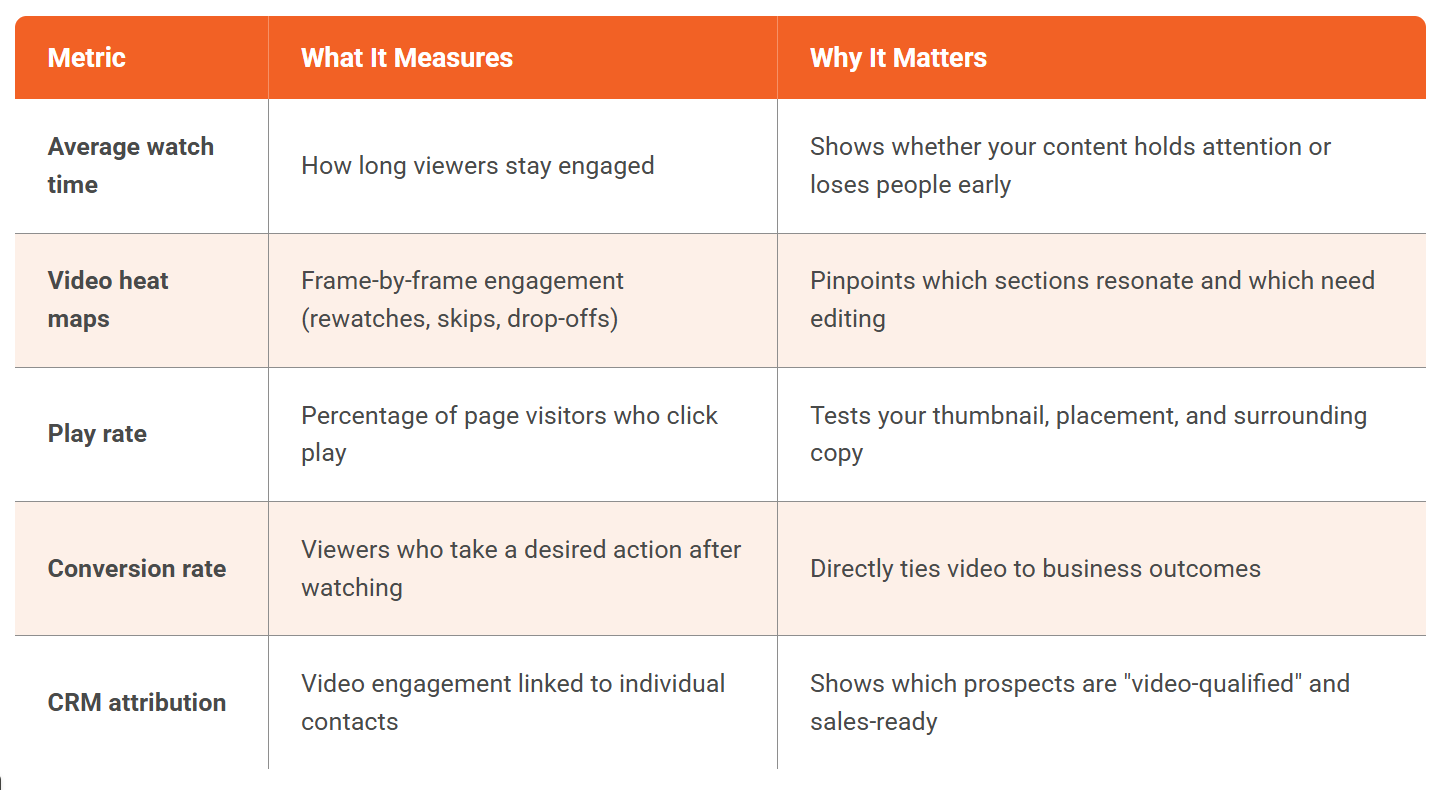
The gap between basic analytics and actionable intelligence comes down to infrastructure. Free platforms give you views and maybe a completion percentage. Enterprise platforms connect engagement data to your CRM, so sales can see which prospects watched which content, for how long, and how many times.
EnterpriseTube's video analytics includes heatmaps, contact-level data, and CRM event connections out of the box. For a deeper look at how to interpret these signals, see our guide on video engagement analytics.
Why Does Video Hosting Infrastructure Matter for Marketers?
Most teams default to YouTube or Vimeo because they're free. That's a reasonable starting point. But as video becomes central to your strategy, the limitations of consumer platforms become real risks.
Three problems surface at scale:
Brand dilution. Third-party platforms insert their own branding, recommend competitor content, and serve ads alongside your videos. Your product demo might autoplay into a competitor's case study.
Data ownership. Consumer platforms own the viewer relationship. You get aggregate analytics, but not individual-level engagement data that feeds your CRM or marketing automation. Your video efforts end up siloed, disconnected from pipeline.
Global delivery gaps. Consumer platforms are blocked or throttled in certain regions. China blocks YouTube, Vimeo, and most Western video hosts. If your target market includes Asia-Pacific buyers, you need infrastructure that delivers reliably to restricted regions.
The alternative is owned video infrastructure: hosting on your branded domain with your own analytics, your own player, and your own audience data. EnterpriseTube's video marketing platform gives marketing teams full control without building from scratch.
What Should a Video Marketing Tech Stack Include?
A complete video marketing tech stack has five layers. Most teams have pieces of this in place but miss one or two layers that limit their effectiveness.
1. Content Management
A centralized library where all video assets live, organized by campaign, product line, audience, or funnel stage. The platform should support multiple content formats (not just video, but images, documents, and audio) so your marketing library isn't fragmented across tools. Look for metadata tagging, collections, playlists, and version control so you can update a video without breaking every embed link on your site.
2. Distribution and Delivery
Your hosting platform needs adaptive bitrate streaming (adjusting quality to the viewer's connection speed), a content delivery network (CDN) for geographic performance, and cross-device compatibility. For global marketing, verify that the platform delivers to your target regions without buffering or access restrictions.
3. Engagement and Interactivity
Static video is one-way communication. Interactive elements like in-video CTAs, polls, chaptering, and clickable links turn passive viewers into active participants. Forrester Research has found that interactive content generates 2x more conversions than passive content, and video is no exception.
4. Analytics and Attribution
You need two types of analytics: content-level (which videos perform, where viewers engage or drop off) and contact-level (which individuals watched what, linked to your CRM records). The second type is what turns video from a broadcast medium into a lead intelligence tool. Integration with Google Analytics, HubSpot, or Salesforce makes this possible.
5. Branding and Customization
White-labeled video portals, branded players, custom domains, and configurable layouts ensure your video presence reinforces your brand identity instead of someone else's. This matters especially for B2B companies where trust and professionalism influence buying decisions.
How Do Leading Teams Use Video Heat Maps to Optimize Content?
Video heat maps are the most underused analytics tool in marketing. A heat map shows frame-by-frame viewer behavior: which segments people rewatch, where they skip, and the exact moment they leave.
Here's what actionable heat map analysis looks like:
- Rewatch spikes indicate your strongest message. Extract that segment as a standalone social clip or move it earlier in future videos.
- Drop-off cliffs show where you're losing people. If 40% of viewers leave at 90 seconds, your intro is too long or the value proposition is buried.
- Skip patterns tell you what your audience considers filler. If everyone skips your company overview slide, cut it from the template.
Teams that restructure content around proven engagement patterns consistently see meaningful lifts in average watch time. Each video informs the next. EnterpriseTube's AI-powered video search also lets viewers jump directly to the moments that matter, reducing drop-off from navigation friction.
How EnterpriseTube Powers Video Marketing for Enterprise Teams
VIDIZMO EnterpriseTube is built for organizations that need more from video than a hosting platform. It addresses the infrastructure gaps that hold most enterprise marketing teams back:
- White-labeled portals with custom domains: Your video library lives on your brand's domain with your CSS, logo, and fonts. No ads, no competitor recommendations.
- Video heat maps and engagement analytics: Frame-level data showing exactly where viewers engage, rewatch, or drop off. Real-time dashboards connect content performance to business outcomes.
- CRM integration: Native connections to HubSpot and Salesforce link individual video engagement to CRM records so sales teams see which prospects are most engaged.
- Global delivery including restricted regions: Enterprise CDN with edge caching delivers content worldwide, including Mainland China and other regions where consumer platforms are blocked.
- AI-powered transcription in 82 languages: Automatic captions and translations make every video accessible to global audiences without manual subtitling.
Marketing teams at organizations like Campari (training 3,000+ external bartenders across 50+ premium brands) and the National FFA Organization (reaching 1,000,000+ members across all 50 US states) use EnterpriseTube to host, distribute, and measure video content at scales consumer platforms can't support.
Ready to take control of your video marketing experience? Contact us too see how EnterpriseTube helps in video management, analytics, and global delivery can transform your marketing results.

Building a Video Marketing Distribution Strategy
Creating great video content is half the challenge. Getting it in front of the right audience is the other half. A distribution strategy should cover three channels:
Owned Channels
Your website, branded video portal, email campaigns, and blog. These are your highest-converting channels because visitors already have intent. Embed videos on landing pages, product pages, and resource centers. According to the Content Marketing Institute, video on landing pages can increase conversion rates by up to 80%.
Social Channels
LinkedIn is strongest for B2B. YouTube rewards longer, searchable content with strong retention signals. Twitter/X works for real-time engagement, and Facebook for broad reach. Each platform favors different formats and lengths. LinkedIn's algorithm, for instance, rewards native video uploads under three minutes.
Paid Channels
Pre-roll ads, sponsored social posts, and programmatic video. Paid distribution accelerates awareness-stage content and retargets mid-funnel prospects who engaged with earlier videos. The key: use engagement data from your owned channels to inform your paid targeting. If a specific customer testimonial drives conversions on your site, amplify it with paid spend.
Common Video Marketing Mistakes and How to Avoid Them
Producing without a brief. Every video needs a documented purpose: target audience, funnel stage, key message, desired action, and success metric. Without it, you produce content that looks good but doesn't serve a strategic function.
Ignoring accessibility. Captions aren't optional. WCAG 2.2 AA standards apply to web content, and many enterprise buyers require vendor compliance. Automatic transcription and captioning should be part of your production workflow, not an afterthought.
Siloing video data. If your video analytics live in one platform and your CRM in another, you're making decisions with incomplete information. Integration between video engagement and marketing automation is what turns "we made a video" into "this video influenced $2M in pipeline."
Neglecting post-publish optimization. Most teams publish and move on. The best teams review heat map data after 500 views, update underperforming intros, A/B test thumbnails, and repurpose high-engagement segments. Video marketing is iterative, not one-and-done.
Frequently Asked Questions
What is video marketing?
Video marketing is the strategic use of video content to promote products, services, or brands across digital channels. It includes formats like explainer videos, product demos, customer testimonials, webinars, and brand stories, distributed across owned websites, social platforms, and paid channels. Effective video marketing ties every piece of content to a measurable business outcome, not just view counts.
How does video marketing compare to traditional content marketing?
Video marketing generates significantly higher engagement and retention than text or image-based content. HubSpot research shows video content receives 1,200% more social shares than text and images combined. Where traditional content marketing excels at SEO and long-form education, video excels at emotional connection, product demonstration, and audience retention across every funnel stage.
What metrics should I track to measure video marketing ROI?
Track engagement depth (average watch time, completion rate), behavioral patterns (video heat maps showing rewatch and drop-off points), conversion actions (form fills, demo requests after viewing), and CRM attribution (linking individual viewer engagement to pipeline and revenue). View counts alone tell you almost nothing about business impact.
Why should enterprises host videos on their own platform instead of YouTube?
Enterprise-owned video hosting provides full brand control (no ads, no competitor recommendations), individual-level analytics with CRM integration, global delivery to restricted regions like China, and compliance with security requirements like SSO, RBAC (Role-Based Access Control), and encryption. YouTube sacrifices brand control and data ownership for free distribution. VIDIZMO EnterpriseTube gives organizations the infrastructure to own their video marketing experience end to end.
How do video heat maps improve marketing performance?
Video heat maps show frame-by-frame viewer behavior: rewatches, skips, and drop-offs. Marketers use this data to identify their strongest messaging (rewatch spikes), cut ineffective segments (skip patterns), and fix structural problems (drop-off cliffs). Teams that iterate on content using heat map data consistently see measurable improvements in average watch time.
What video formats generate the most leads for B2B companies?
Product walkthroughs, customer testimonial videos, and webinar recordings are the highest-converting formats for B2B lead generation. Walkthroughs work because they address specific buyer questions. Testimonials provide third-party validation from recognizable companies. Webinar recordings offer on-demand access to high-value educational content that prospects are willing to exchange contact information to access.
How important is video accessibility for marketing content?
Video accessibility is both a legal requirement and a business advantage. WCAG 2.2 AA standards require captions and audio descriptions for web content, and many enterprise buyers mandate vendor compliance. Beyond compliance, captions increase engagement: viewers are significantly more likely to watch an entire video when captions are available. AI-powered transcription in platforms like EnterpriseTube supports 82 languages, making global accessibility practical at scale.
About the Author
Jump to

Video Engagement: How to Measure What Your Viewers Actually Watch

Closed Captions vs. Subtitles in Video CMS: Key Points and Differences


No Comments Yet
Let us know what you think