Enterprise video rarely fails because teams do not create enough content. It fails when delivery breaks under real network conditions. Offices deal with shared bandwidth, remote users, VPN traffic, and inconsistent connectivity. When video stalls or buffers, adoption drops fast.
Over time, many organizations learn that video quality alone does not solve this problem. High resolution streams look good in controlled environments, but struggle in distributed enterprise networks. What matters more is how well the platform adapts when bandwidth changes.
This is where adaptive bitrate streaming becomes a deciding factor. It allows video to adjust in real time to network conditions, keeping playback smooth across offices, devices, and locations. Without it, even well produced content becomes difficult to consume.
Choosing an enterprise video platform with adaptive bitrate streaming goes beyond checking a feature box. It requires understanding how the platform encodes, delivers, secures, and scales video across the organization. The sections that follow outline what to evaluate and why adaptive delivery plays a central role in enterprise video success.
Why Adaptive Bitrate Streaming Matters in Enterprise Video Platforms
Enterprise networks behave differently from consumer environments. Bandwidth fluctuates as employees join meetings, access cloud tools, and connect from remote offices. A video platform must perform under these conditions, not just in ideal scenarios.
Adaptive bitrate streaming allows a platform to respond to these changes in real time. Instead of pushing a fixed quality stream, it delivers video at a bitrate the network can support at any moment. Playback continues even when capacity drops.
Without adaptive delivery, buffering becomes common. Users abandon videos, training completion drops, and confidence in the platform erodes. Over time, teams avoid video for critical communication because reliability feels uncertain.
An enterprise video platform with adaptive bitrate streaming treats network variability as normal. This approach ensures consistent playback across headquarters, branch offices, and remote users, making video dependable for daily operations.
Criteria to Look For When Choosing an Enterprise Video Platform
Selecting an enterprise video platform with adaptive bitrate streaming requires more than confirming ABR support. The following criteria determine whether adaptive delivery works reliably at scale.
Adaptive Bitrate Streaming Implementation
Not all adaptive bitrate implementations perform the same. Look for platforms that support standards such as HLS and MPEG DASH and switch bitrates smoothly based on real time network conditions. Poor implementations cause visible quality jumps or delayed adaptation.
A strong platform adjusts before buffering occurs and supports a wide range of bitrates to handle low bandwidth offices and high capacity environments alike.
Encoding and Transcoding Flexibility
Adaptive streaming depends on having multiple video renditions available. The platform should support automated transcoding into multiple resolutions and bitrates without manual effort.
This ensures each viewer receives a stream suited to their device and network. Limited encoding options reduce the effectiveness of adaptive bitrate streaming.
Network and Device Awareness
An enterprise video platform should detect device capabilities, screen size, and browser support in addition to bandwidth. Sending high bitrate streams to devices that cannot display them wastes network capacity.
Effective platforms balance network conditions and device constraints to deliver stable playback across desktops, mobile devices, and thin clients.
Performance in Low Bandwidth and Remote Offices
Many platforms perform well in headquarters environments but struggle in remote locations. Evaluate how the platform handles shared WAN links, VPN connections, and high latency networks.
Adaptive bitrate streaming should maintain playback continuity even when conditions fluctuate. Testing in real office scenarios reveals this capability.
Security and Access Control During Streaming
Adaptive delivery should not weaken security. Look for encrypted streaming, secure token based access, and role based permissions applied consistently across all bitrates.
Enterprise platforms must enforce the same access rules regardless of network conditions or stream quality.
Analytics and Playback Insights
Understanding how adaptive bitrate streaming performs helps improve video strategy. Platforms should provide visibility into buffering events, bitrate switching, and viewer engagement.
These insights allow IT and content teams to identify network issues and optimize video delivery over time.
Scalability and Reliability
As video usage grows, adaptive bitrate streaming must scale without degrading performance. The platform should support concurrent viewers across locations without overloading network links or servers.
Reliable delivery during peak usage indicates a mature adaptive streaming architecture.
How EnterpriseTube Meets These Criteria
EnterpriseTube is built for organizations that rely on video as a core knowledge and communication channel. Its adaptive bitrate streaming capabilities address the realities of enterprise networks rather than ideal lab conditions.
Adaptive Bitrate Streaming Designed for Enterprise Networks
EnterpriseTube supports standards based adaptive bitrate streaming that adjusts video quality in real time. Playback adapts smoothly as bandwidth fluctuates, reducing buffering across headquarters, branch offices, and remote users.
Automated Multi Bitrate Encoding
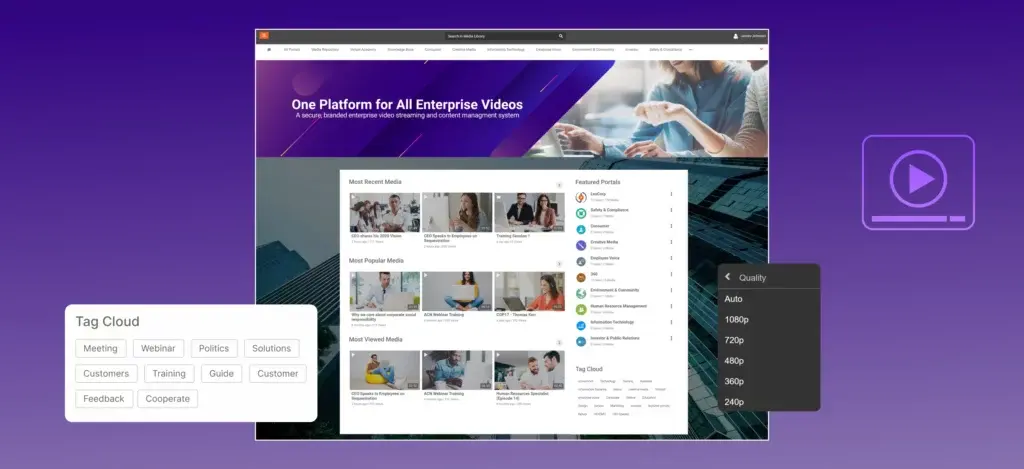
EnterpriseTube automatically transcodes videos into multiple resolutions and bitrates. This ensures adaptive delivery works effectively without manual configuration. Viewers receive streams suited to their network and device capabilities.
Device and Network Aware Playback
EnterpriseTube detects device type, screen size, and browser support during playback. Combined with bandwidth awareness, this allows the platform to deliver stable video across desktops, mobile devices, and thin clients without overloading the network.
Performance in Low Bandwidth Environments
EnterpriseTube is designed to perform in constrained networks. Adaptive bitrate streaming maintains continuity over shared WAN links, VPN connections, and high latency environments where fixed bitrate delivery fails.
Secure Adaptive Streaming
Security remains consistent across all bitrate levels. EnterpriseTube enforces encryption, role based access control, and secure streaming tokens, ensuring sensitive video content stays protected during delivery.
Playback Analytics and Visibility
EnterpriseTube provides insights into viewing behavior, bitrate switching, and playback performance. These metrics help organizations identify network challenges and refine their video strategy.
Scalable and Reliable Video Delivery
EnterpriseTube scales to support growing libraries and concurrent viewers without sacrificing playback quality. Its adaptive streaming architecture supports enterprise growth while maintaining reliability.
Choosing the Right Enterprise Video Platform With Adaptive Bitrate Streaming
Adaptive bitrate streaming plays a central role in enterprise video success. Without it, buffering, stalled playback, and uneven performance undermine adoption across offices and remote teams.
When evaluating an enterprise video platform, adaptive delivery should not be treated as a simple feature check. The quality of implementation, encoding flexibility, device awareness, security, analytics, and scalability determine whether video performs under real network conditions.
EnterpriseTube aligns with these requirements by combining adaptive bitrate streaming with enterprise grade security, governance, and performance. It supports reliable video delivery across low bandwidth offices, distributed teams, and growing libraries.
Choosing the right platform ensures video remains a dependable channel for knowledge sharing, training, and communication, even as networks and usage patterns evolve.

Key Takeaways
-
Enterprise networks experience fluctuating bandwidth, which makes fixed bitrate video unreliable.
-
Adaptive bitrate streaming keeps playback smooth by adjusting video quality in real time.
-
Choosing an enterprise video platform requires evaluating how well adaptive streaming is implemented, not just whether it exists.
-
Encoding flexibility, device awareness, and low bandwidth performance determine real world playback quality.
-
Security and access control must remain consistent across all adaptive streams.
-
Analytics help teams understand playback performance and network impact.
-
EnterpriseTube delivers adaptive bitrate streaming designed for enterprise scale, security, and network variability.





No Comments Yet
Let us know what you think