
by Hassaan Mazhar, Last updated: July 16, 2026
%20Platforms%20in%202026_%20A%20Buyers%20Framework.webp)
Choosing a video on demand platform is not about finding the "best" one, it's about finding the right fit for your organization's workflows, compliance requirements, and long-term strategy. This guide replaces hype with a structured evaluation framework: objective criteria, a feature matrix, pricing transparency, deployment complexity ratings, and honest assessments of when a competitor may be a better fit than VIDIZMO.
Use this as your evaluation checklist. Download the template at the end to run your own scoring exercise.
What Is a Video on Demand (VOD) Platform?
A video on demand platform stores, organizes, and streams pre-recorded video content for audiences to watch at any time, on their schedule. Enterprise VOD platforms go beyond simple hosting: they add access controls, AI-powered search, analytics, interactivity, and compliance tooling that consumer platforms like YouTube do not provide.
Common enterprise use cases for VOD platforms:
- Corporate training and L&D — onboarding videos, compliance training, SCORM-based courses
- Internal communications — executive messages, policy updates, change management
- Knowledge management — searchable video libraries, meeting recordings, institutional knowledge
- Marketing and external content — product demos, customer stories, gated webinar replays
- Regulated content delivery — HIPAA-compliant medical education, CJIS-compliant law enforcement training
The 4 Dimensions That Actually Matter
Most vendor comparison articles rank platforms on a single "best" list. That approach fails buyers because no single platform leads on every dimension. We've structured this guide around six evaluation dimensions that distinguish platforms in practice:
- Feature depth and AI capabilities
- Compliance standards and certifications
- Integration ecosystem depth
- Deployment flexibility and complexity
Dimension 1: Feature Matrix
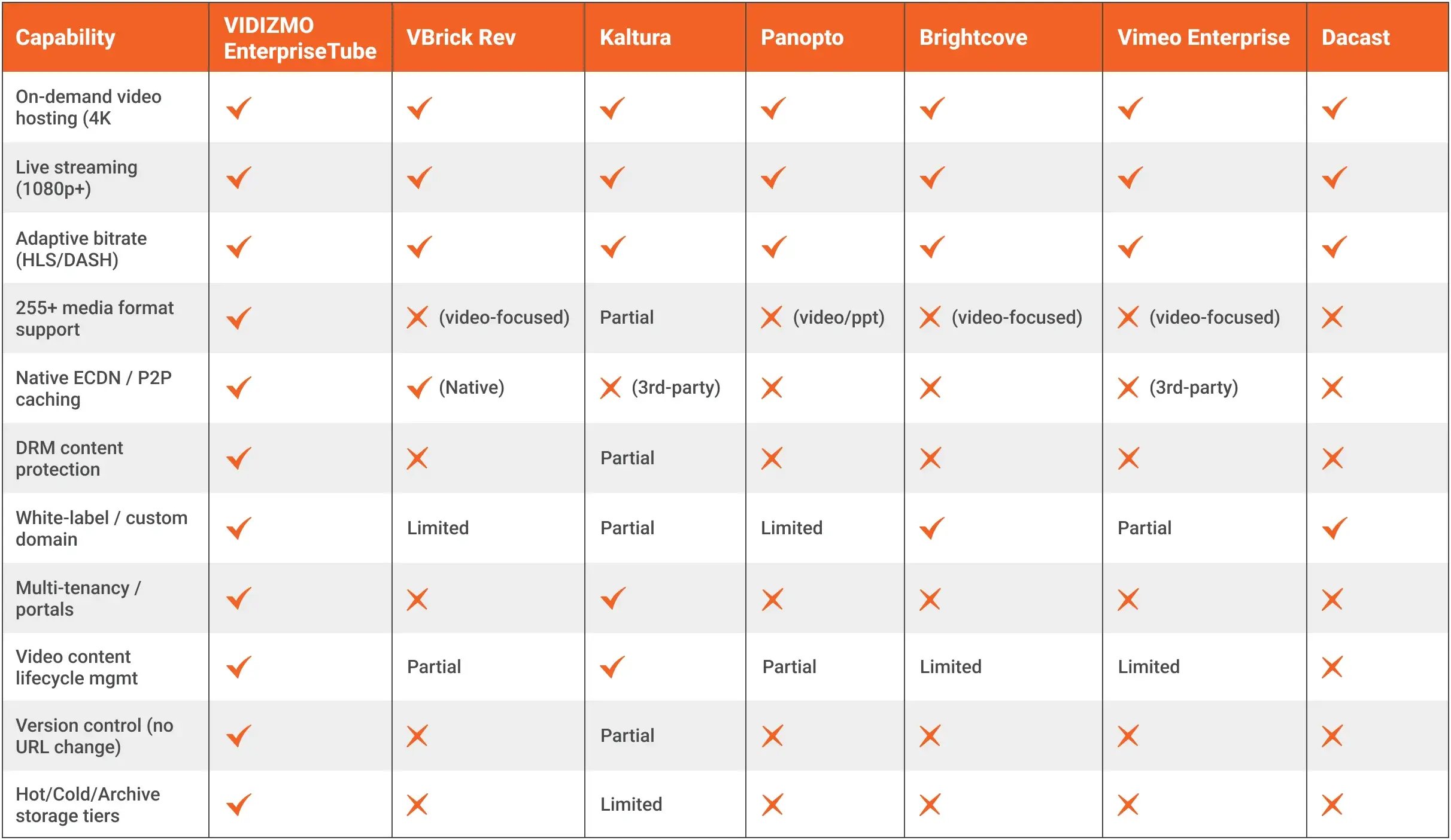
Use this matrix to score platforms against your requirements. Mark each capability as Required (R), Nice-to-Have (N), or Not Needed (-) before consulting vendor materials.
Core VOD and Streaming Features
AI and Intelligence Features
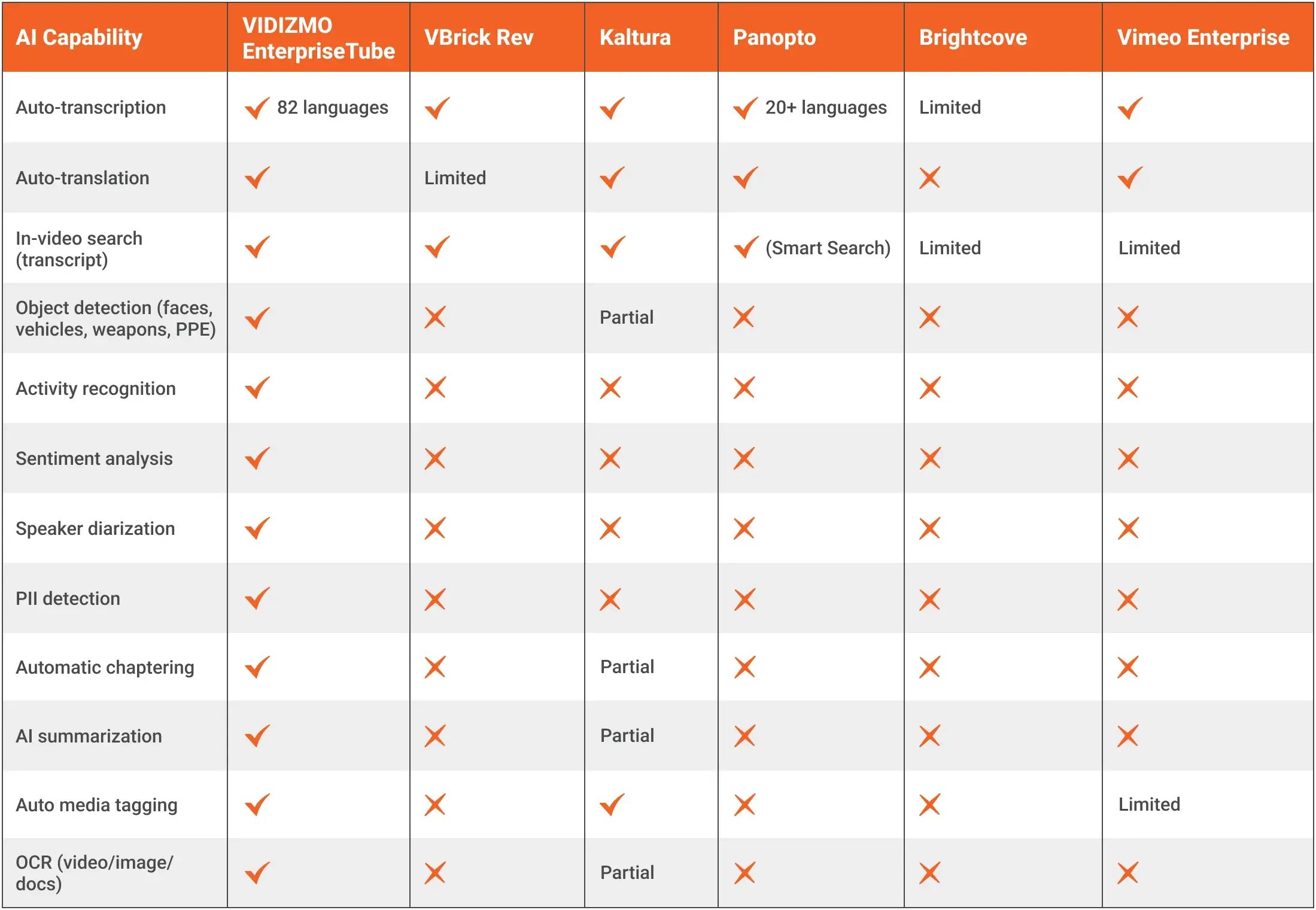
Key takeaway: VIDIZMO's AI feature set is broader than any single competitor in this comparison, particularly for regulated-industry use cases requiring PII detection, activity recognition, and object tracking. Panopto's Smart Search is widely regarded as leading for education-centric transcript search. Kaltura offers a broad AI suite for its scale of deployment.
Interactivity and Learning Features
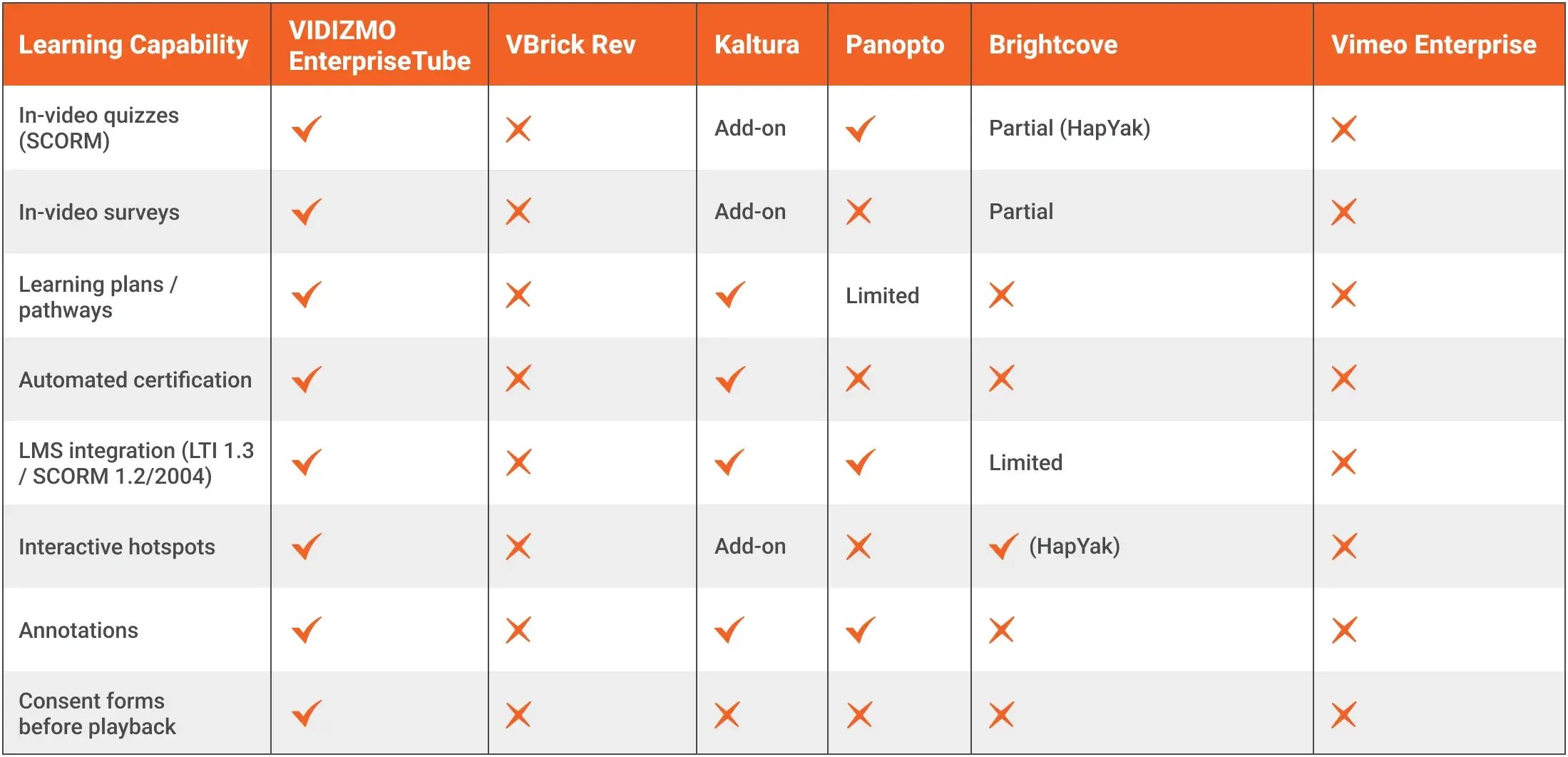
Key takeaway: Organizations with structured L&D programs should prioritize native SCORM/LTI support and learning paths. VIDIZMO and Kaltura lead here; Panopto is strong for education but weaker for enterprise training workflows.
Dimension 2: Compliance Standards
Compliance is not a checkbox, it determines whether a platform is legally viable for your organization's data and content.
Compliance Matrix by Industry
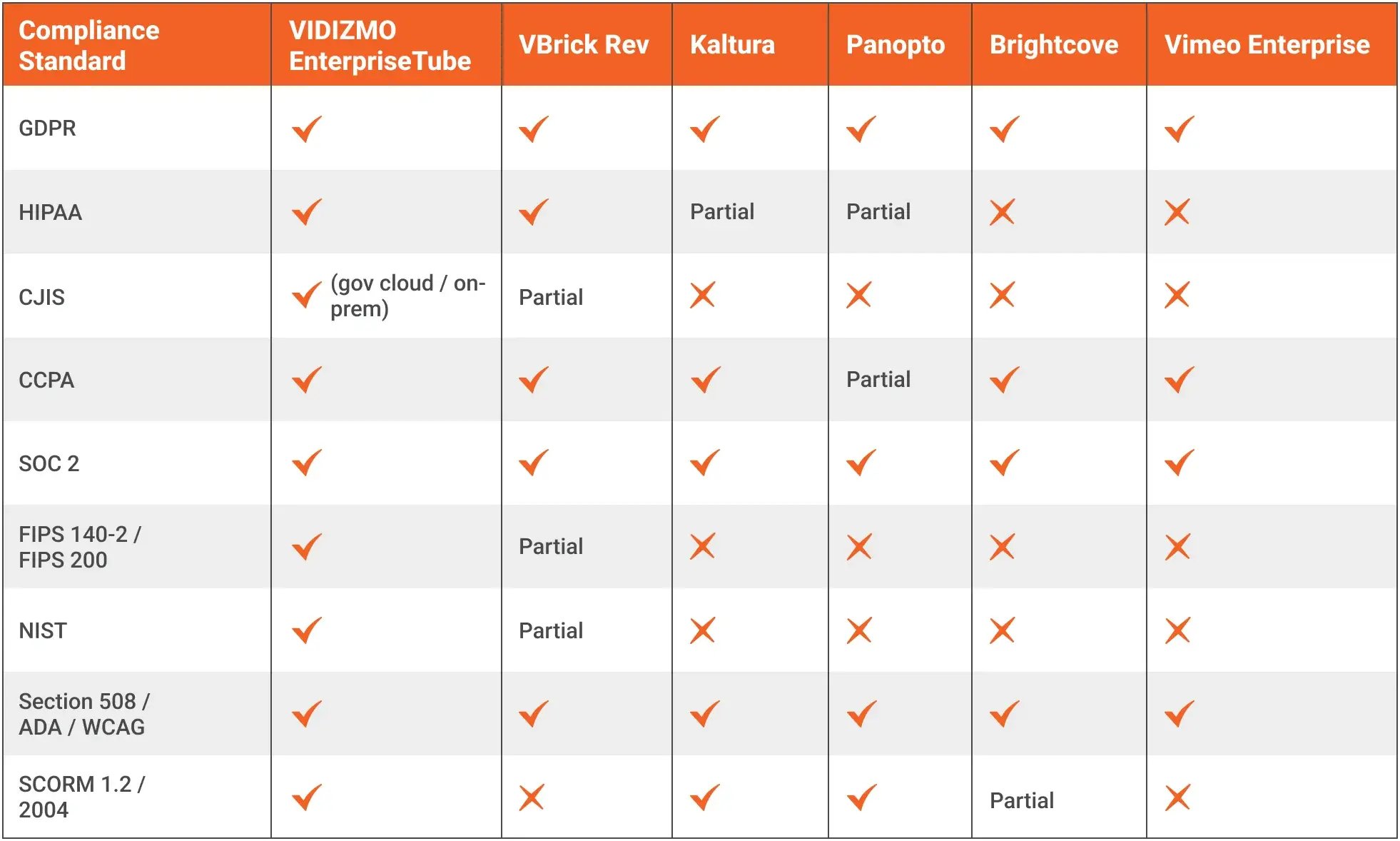
How to apply this matrix:
-
Healthcare organizations require HIPAA BAA capability, eliminate platforms without it
-
Law enforcement and government agencies must evaluate CJIS compliance and on-premises or government cloud deployment
-
Global enterprises must verify GDPR data residency controls, not just claimed compliance
-
Federal contractors should assess FIPS 140-2 encryption standards
Note on compliance claims: Certification status changes over time. Always request the vendor's current compliance documentation and ask specifically whether the certification covers your deployment model (SaaS shared, dedicated, or on-premises).
Dimension 3: Integration Depth
Deep integrations reduce friction, eliminate manual workflows, and make your video platform part of existing IT infrastructure rather than a silo.
Integration Ecosystem Comparison
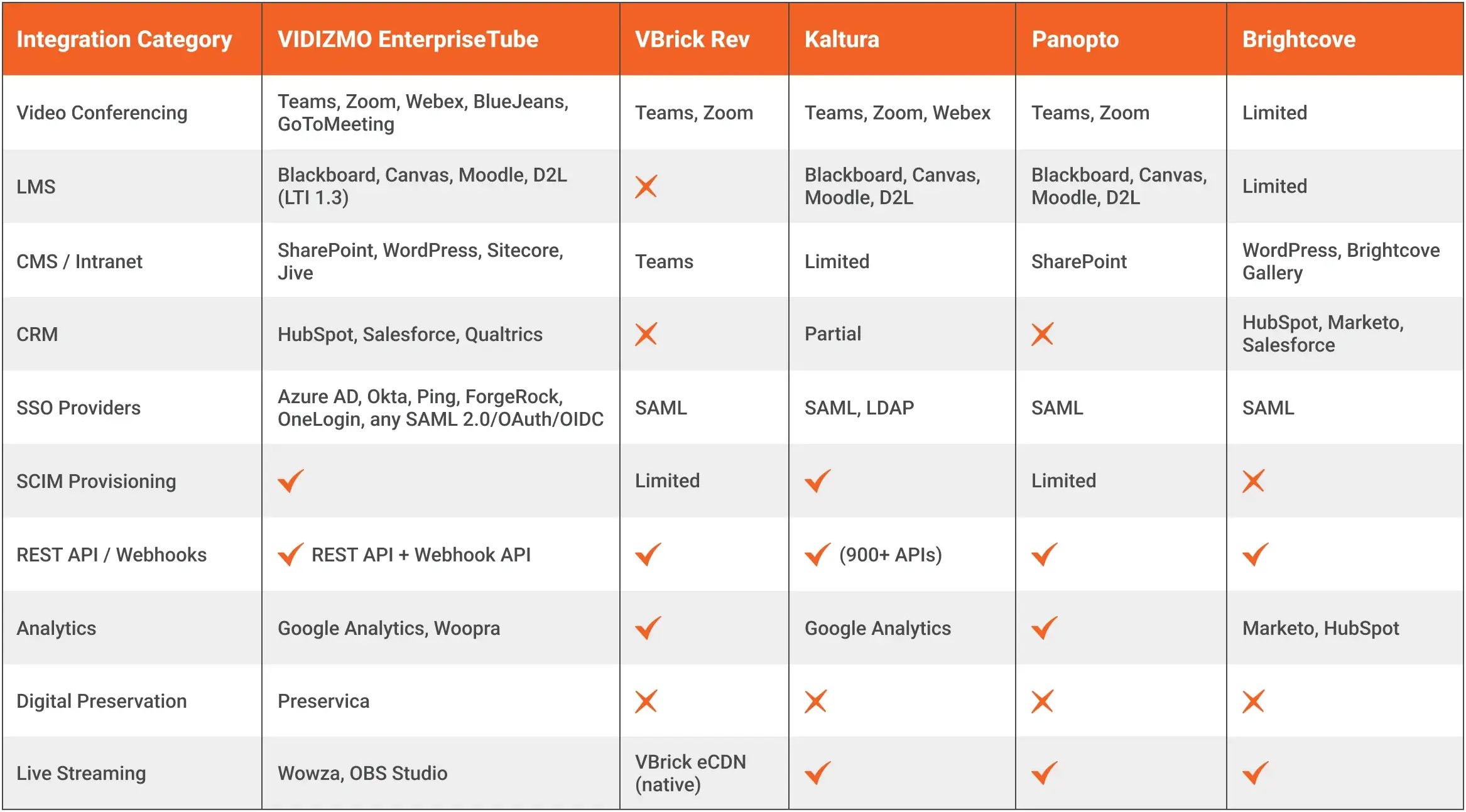
Integration evaluation questions to ask vendors:
-
Is LMS integration native or does it require a third-party connector?
-
Does SSO cover both internal users and external/anonymous viewers?
-
Are API rate limits documented, and what is the SLA for API availability?
-
Can video conferencing recordings be automatically ingested without manual steps?
Dimension 4: Deployment Options and Complexity
Deployment model determines data residency, network latency, IT burden, and total cost. Many platforms advertise "flexible deployment" but restrict premium features to their cloud offering.
Deployment Model Comparison
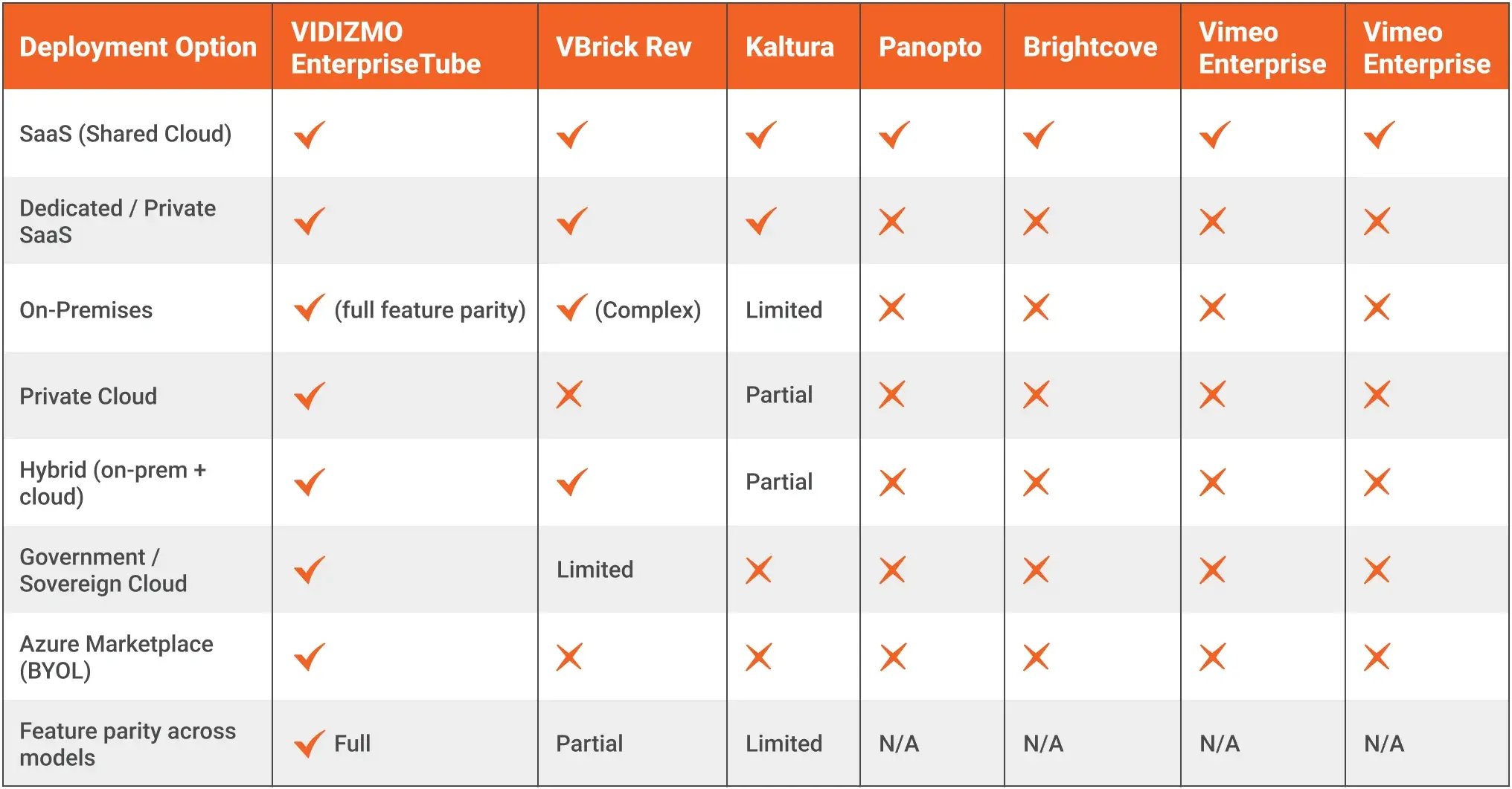
Deployment Complexity Ratings (1 = Simple, 5 = Complex)
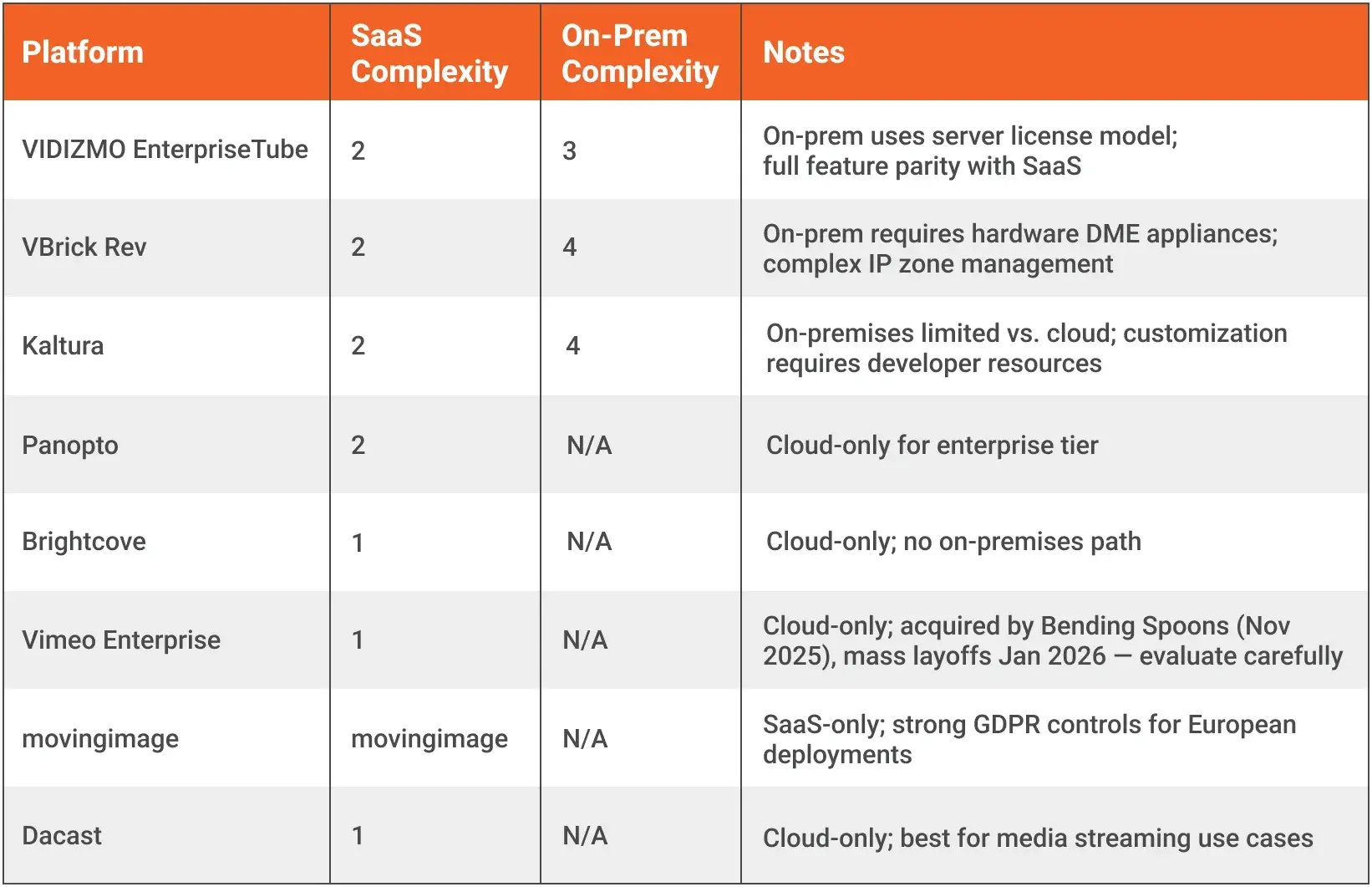
Key questions to ask on deployment:
-
Does the on-premises offering have feature parity with the SaaS version, or is it a reduced build?
-
What is the minimum server specification for on-premises deployment?
-
Can content be migrated between deployment models without data loss?
-
Who manages server patching and updates in an on-premises scenario?
Platform Profiles: Honest Assessments
VIDIZMO EnterpriseTube
Gartner-recognized AI-powered enterprise video content management platform.
Best fit for:
-
Organizations needing on-premises, government cloud, or hybrid deployment
-
Regulated industries requiring HIPAA, CJIS, FIPS 140-2 compliance
-
L&D programs requiring SCORM/LTI integration, in-video quizzes, and certification tracking
-
Enterprises needing deep AI (82-language transcription, object detection, PII detection, activity recognition)
-
Multi-entity organizations needing white-labeled portals with independent security policies
Where competitors may be a better fit:
-
If your primary need is external marketing video with server-side ad insertion, Brightcove is more purpose-built
-
If you are in higher education with existing Canvas/Moodle LMS infrastructure, Panopto's Smart Search and lecture capture workflows may be better optimized
-
If you need purely low-latency broadcast-quality video encoding hardware, Haivision's encoder products are specialized
-
If your team is small (under 50 users) and needs simple video hosting without enterprise compliance, Vimeo's lower tiers or Dacast may be more cost-effective
Compliance certifications: GDPR, HIPAA, Section 508, ADA, WCAG, CCPA, CJIS (government cloud/on-prem), SCORM, SOC 2, FIPS 140-2, FIPS 200, NIST
Deployment options: SaaS (Shared/Dedicated), Cloud (Government/Commercial), On-Premises, Private Cloud, Hybrid, Azure Marketplace (BYOL and Transact)
VBrick Rev
Enterprise-grade video platform with native eCDN, recognized leader for large-scale corporate webcasting.
Best fit for:
-
Fortune 500 organizations streaming to 10,000+ concurrent viewers
-
Corporate communications teams running 30–100 webcasts per month
-
Enterprises already investing in Microsoft Teams / ServiceNow ecosystems
Limitations to evaluate:
-
Interactive video (quizzes, surveys, hotspots) is largely absent
-
On-premises deployment requires hardware appliances and complex IP zone management
-
Mobile viewing experience has been flagged by users as below par
-
Premium pricing positions it out of reach for mid-market organizations
Kaltura
Comprehensive, API-extensible platform with dominant higher education presence.
Best fit for:
-
Higher education institutions with Canvas, Moodle, Blackboard, or D2L LMS
-
Large enterprises needing OTT and broadcast capabilities alongside enterprise video
-
Organizations with development resources to use the 900+ API ecosystem
Limitations to evaluate:
-
Steep learning curve; significant IT involvement for customization
-
Financial uncertainty, profitability challenges despite $181M ARR
-
On-premises offering has less feature parity than the cloud version
-
Pricing complexity makes TCO difficult to predict
Panopto
AI-powered video platform with industry-leading Smart Search, primarily for education and enterprise knowledge management.
Best fit for:
-
Universities and research institutions (21 of the world's top 25 universities use Panopto)
-
Enterprise knowledge management and training where fast, precise in-video search is the priority
-
Organizations using Zoom/Teams whose recordings need automatic ingestion
Limitations to evaluate:
-
Dated user interface reported by multiple reviewers
-
Education-centric design means weaker multi-tenancy, white-labeling, and advanced branding
-
No enterprise-grade compliance (HIPAA, CJIS, FIPS) for regulated industries
-
Per-user pricing is cost-prohibitive for broad viewer access
Brightcove
Marketing and media-optimized video platform with Emmy Award-winning infrastructure.
Best fit for:
-
Media companies, broadcasters, and OTT operators
-
Marketing teams needing server-side ad insertion (SSAI), lead capture, and CRM integration
-
Organizations requiring global CDN reliability for external-facing content
Limitations to evaluate:
-
Cloud-only, no on-premises or hybrid option
-
Limited compliance certifications for regulated industries (HIPAA, CJIS absent)
-
Navigation and content organization at scale is weaker than dedicated enterprise CMS platforms
-
Enterprise pricing escalates significantly with bandwidth and add-on modules
Vimeo Enterprise
Well-known video hosting brand, now operating under new ownership post-acquisition.
Critical update for 2026 buyers: Vimeo was acquired by Bending Spoons (Milan, Italy) in November 2025 and delisted from NASDAQ. In January 2026, Vimeo conducted mass layoffs following the acquisition. Product roadmap, support quality, and long-term platform viability are uncertain. Organizations with 3–5 year platform commitments should evaluate this risk carefully.
Still suitable for:
-
Marketing teams and creative professionals needing clean video playback with branding
-
Small-to-mid teams on lower tiers (Starter through Advanced) for video hosting without enterprise compliance
Limitations to evaluate:
-
Cloud-only; no on-premises or hybrid deployment
-
Hard storage and bandwidth caps that force upgrade
-
Enterprise compliance (HIPAA, CJIS) not available
-
Ownership and staffing uncertainty
Dacast
Transparent-priced streaming platform for media, events, and content monetization.
Best fit for:
-
Media organizations, houses of worship, and sports organizations needing live streaming with built-in monetization -
-
Organizations with under 5 users needing affordable video hosting and streaming
-
Niche use case: streaming to audiences in mainland China (dedicated CDN infrastructure)
Limitations to evaluate: -
-
Not a full enterprise video content management platform
-
Bandwidth overage costs ($0.30/GB) can accumulate unpredictably at scale
-
No enterprise compliance certifications (HIPAA, GDPR-certified, CJIS)
-
Basic analytics, no viewer-level engagement, quiz scoring, or learning tracking
10 Questions to Ask Every VOD Platform Vendor
Before shortlisting, require written answers to these:
- Deployment: Is the on-premises offering feature-identical to your SaaS version, or are certain capabilities restricted to cloud?
- Compliance: Can you provide current SOC 2 Type II, HIPAA BAA, and CJIS documentation for our specific deployment model?
- AI usage costs: Are AI features (transcription, translation, object detection) included in the license, or metered separately?
- Storage and bandwidth: What are included bundle sizes per user, and what are overage rates?
- Integration: Is LMS integration native (LTI 1.3) or do we need a middleware connector?
- SSO: Does SSO cover all users (internal + external/anonymous) or only authenticated users?
- Multi-tenancy: Can we create independent portals with separate branding, security policies, and user bases?
- Migration: Do you provide migration tooling or professional services for migrating from [our current platform]?
- SLA: What is your uptime SLA for live streaming, and what is the compensation mechanism for downtime?
- Pricing stability: What is the standard annual renewal increase, and can it be capped in a multi-year agreement?
Next Steps: Your Evaluation Workflow
Schedule a Product Tour: See VIDIZMO EnterpriseTube with a live demo tailored to your use case and vertical.
Talk to an Expert: Not sure which platform fits your requirements? Schedule a 30-minute fit assessment with a VIDIZMO solutions specialist.

People Also Ask
A VOD (Video on Demand) platform is a system that hosts, manages, and streams video content so users can watch it anytime over the internet. It typically includes video hosting, encoding, playback, security controls, analytics, and delivery via CDN infrastructure.
Live streaming broadcasts video in real time, while VOD allows users to watch pre-recorded content on demand. Many modern platforms support both, but VOD prioritizes content management, playback control, and long-term storage.
A VOD platform stores video files, transcodes them into multiple streaming formats, and delivers them through a content delivery network (CDN). When a user presses play, the platform streams the video adaptively based on their internet speed and device.
Choose a VOD platform based on your use case, security needs, scalability requirements, integrations, analytics depth, and total cost of ownership. Enterprise buyers should also evaluate compliance certifications, API flexibility, and long-term vendor reliability.
Look for secure hosting (DRM and encryption), adaptive bitrate streaming, customizable players, AI transcription, detailed analytics, API access, SSO support, and scalable CDN delivery. Advanced platforms also offer AI-powered search and content intelligence.
VOD platform pricing depends on storage, bandwidth, features, and user volume. Costs may be subscription-based, usage-based, or enterprise-licensed. Entry-level plans may start in the hundreds per month, while enterprise deployments scale significantly higher.
Hidden costs often include bandwidth overages, premium CDN usage, DRM licensing, advanced analytics add-ons, API access fees, storage expansion, migration costs, and custom development. Always assess total cost of ownership—not just base pricing.
A secure VOD platform should include AES encryption, DRM (Widevine, PlayReady, FairPlay), tokenized URLs, role-based access control, domain/IP restrictions, watermarking, and compliance capabilities such as GDPR or HIPAA where required.
Platforms use DRM, encrypted streaming protocols (HLS/DASH), expiring access tokens, and watermarking to limit unauthorized downloads and redistribution. While screen recording cannot be fully prevented, enterprise-grade DRM significantly reduces piracy risks.
A strong VOD platform provides viewer engagement metrics, watch time, completion rates, drop-off analysis, geographic insights, device data, and exportable reports. Enterprise systems may also support user-level tracking and BI integrations.
About the Author
Jump to
Enterprise Video Hosting: Complete Guide to Platforms and Software

VOD Streaming for Enterprises: How to Deliver On-Demand Video at Scale


No Comments Yet
Let us know what you think