
by Daniyal Hassan, Last updated: April 24, 2026
Key Takeaways:
- A white label video streaming platform lets organizations fully customize logos, colors, domains, and players—ensuring every live stream and on-demand video aligns perfectly with their brand identity.
- The best white label video platforms combine branding freedom with security, analytics, and scalability—providing a complete white label VOD platform experience for both live and on-demand content.
- As a white label video on demand platform, EnterpriseTube stands out with deep CSS customization, adaptive streaming, granular access control, and flexible deployment options for enterprises seeking full control and consistency.
Did you know you only have 7 seconds to make an impression of your brand on your audience? How about the fact that 55% of those first impressions are based on a visual element? This is why visual branding is so important to organizations.
For organizations investing in high-quality video content, a white label video streaming platform is essential to make every live stream and VOD session feels like your brand. Whether it's promotional videos, product demos, webinars, or even training videos, organizations need a platform that feels like a coherent part of their brand.
In fact, it's a top priority, given that consistent brand representation across all platforms can increase business revenue by 23%.Traditional video streaming platforms often lack the customization options businesses need.
Luckily, white-label streaming platforms offer the solution to these problems. These platforms allow organizations to completely rebrand their video portal and make it look like their own—whether you need a white label video platform for events or a white label VOD platform for on-demand libraries. The only problem is, with so many white-label video streaming platforms on the market, how do you choose the right one?
To help you find the solution, this blog post will guide you through the key features to consider and compare some of the leading solutions by highlighting their strengths and weaknesses to help you make an informed decision. But before we jump to the solutions, let's understand what white-label streaming platforms are, why they're needed, and what you can expect from them.
What Is a White Label Video Streaming Platform (and How It Differs from a White Label VOD Platform)?
A white-label video streaming platform can be branded using various customization options. Businesses can use it to stream videos online while maintaining their branding guidelines.
In simple terms, a white label video platform lets businesses fully rebrand the portal and player for both live broadcasts and on-demand libraries—functioning as a single white label video on demand platform when you publish recordings. For instance, they can set their logo, color, fonts, domains, and more.
When organizations stream, their viewers can see these branding changes reflected in on-demand and live streaming, which helps with brand recognition and engagement.
Why Businesses Need a White Label Live Streaming Platform
A traditional service rarely meets corporate branding needs. A white label video streaming platform gives you full control of identity, UX, and policy—across live and on-demand experiences. It lacks advanced and granular branding features. Moreover, apart from branding, there are many more factors to consider when creating a video streaming platform. With that in mind, here are some reasons why your organization should consider opting for a platform that offers white label video streaming.
Branding Freedom
Unlike free platforms like YouTube, white-label solutions allow businesses to customize their video portal and player completely to match their brand identity. As research shows, when brands use their signature color, the chances of consumer recognition increase by 80%.
Moreover, white label solutions don't muddy your platform with any third-party advertisements that echo brand messaging and identities other than your own. Also, maintaining brand consistency is key, as it can contribute to 10%-20% growth in revenue.
Think about your website, social media, and print materials… Your video experiences should match, too—live events and your white label video on demand platform where recordings live side-by-side under the same design system. All this can be achieved by using a white-label platform, as it allows you to incorporate those same brand elements to ensure a seamless and recognizable experience for your audience.
Enhanced Security Options
A dedicated white label video streaming platform helps protect your content with enterprise controls (RBAC, AES, tokenized URLs, SSO, IP/geo restrictions) applied consistently to live and VOD. Unlike relying on public streaming solutions that have their own security considerations in mind, white-label platforms offer a host of security features so businesses can tailor them to fit their risk level and security needs. These features can include role-based access control (RBAC), AES encryption, tokenized URLs, domain restrictions, IP restrictions, SSO support, and more.
Moreover, some platforms even allow organizations to set automatic login timeouts, audit logs, and granular access controls, like category access, to secure their video content. By taking advantage of these features, organizations can create a secure environment for their file hosting and streaming. This gives them peace of mind to protect their valuable video content.
Complete Content Ownership
When you use a social media platform like YouTube, you're at the mercy of how they operate the platform. Frequent content policies and decisions change the way the platform operates and the content allowed on it.
In contrast, white-label platforms let you have control of your content. You will not have to worry about following ever-changing guidelines from other platforms, which can sometimes lead to your content being removed unexpectedly.
This freedom also extends to the streaming experience. Unlike free platforms that bombard viewers with ads, white-label solutions do not force ads or interruptions to ruin the stream. This lets you create a cleaner, more premium viewing experience without disruptions.
Types of Customization in a White-Label Video Streaming Platform
A brandable video platform comes with several customization options. Depending on the specific platform, they can be partially or fully customizable according to the user's needs. Typically, you can expect the following customization options in the white-label video streaming solution.
Brand Logo
Without a doubt, the logo is the most crucial part of branding. When viewers see your logo prominently displayed during playback or within the platform interface, they instantly recognize who's providing the content. If they've seen your logo elsewhere (on social media, website, etc.) and had a positive experience, seeing it again on the video platform reinforces that positive association.
A white label video platform will allow you to strategically place your logo in places so that people can recognize your brand. Some platforms may even go beyond it to change your video portal's background, too.
Theme Color
A white label video streaming platform allows businesses to customize the theme colors of their video player and portal. Colors significantly influence brand recognition, enabling organizations to present a consistent visual identity to their viewers.
Fonts
Just like logos and colors, fonts are an inherent part of a brand's design DNA and play an important role in identifying it. It's hard not to picture Casio when you see Eurostile or Cisco when looking at Futura Bold.
Video streaming platforms with white-label functionalities help you get your brand's look and feel integrated into the UI and other elements by letting you set the custom font for your entire portal.
Language Preference
If you plan on streaming to diverse locations across the world, you can expect your viewers to speak diverse languages. As an organization, you never want to make navigation and use of the portal hard because they can't understand the language.
Most white label video streaming platforms allow businesses to change the language of the video portal and select one of their choices. It is beneficial, especially when you have a global audience.
Player Template
Although not directly related to branding, player templates are an important part of white labelling. If you like to keep a consistent look and feel across your portal, then you may need the option to customize which options show up in your video player to offer a streamlined user experience.
There can be different video player templates on a white-label platform, allowing you to select the one that best suits your needs. You can add a custom player template to set your preferred display and control settings.
Domains
Domains are also a key element in brand identity. When someone opens a URL leading to your portal, you want them to recognize your brand from the address bar and have confidence that they're on the right site. Within a white label video platform, businesses can add custom domains and managed SSL so every white label VOD platform page and live event loads on trusted, branded URLs.
Custom CSS
Some organizations like to go beyond basic customization to have granular control over the particulars of their customization. This allows them to fine-tune their portal and player for an optimal look and feel. Some white label video on demand platforms and live solutions allow granular CSS styling—useful when brand systems require pixel-perfect controls beyond built-in theming. If the default customization options do not work for you, this can be a great option to customize the interface further to meet your preferred requirements.
How to Choose the Right White Label Video Streaming Platform (and VOD)
Thinking of adopting a white label video platform? Weigh live needs and your white label VOD platform requirements together, since most teams publish recordings post-event. There are several platforms out there on offer, and getting the one you want may boil down to the one that's most suitable for your needs. With that in mind, here are some key factors every organization should consider before making its choice.
Customization and Branding
It's a no-brainer that choosing a white-labeling platform will require that you consider customization and branding options. Branding is crucial for many businesses, and white-labeling allows you to extend your brand identity to your live stream.
A key factor when choosing a video streaming service is the level of branding and customization it offers. Look for a platform that provides extensive control over the platform's appearance and functionality.
Logos are the absolute bare minimum that any competent platform can muster. However, you want to look beyond that and find something that can let you customize fonts, colors, and other elements. Bonus points if you can find a platform that lets you customize it entirely using CSS styling.
Security and Privacy
Live streaming and on-demand video content contain a wealth of information for organizations. This is especially true in the case of confidential recorded meetings, investor relations videos, executive communication videos, etc.
To protect proprietary, personal, and confidential data, you must assess the security and privacy features of the platform you're opting for. Look for a platform that offers capabilities for encryption, Digital Rights Management, access control, secure sharing, audit logs, and other features your organization may require.
Analytics
Video analytics have a significant importance for businesses. Based on these metrics, the host can make intelligent decisions. You can try using third-party platforms to track analytics, but that's already an extra step.
Instead, try to look for a platform that offers granular video streaming analytics such as user analytics, interactivity trends, content interaction analytics, and more. And if it can integrate with other analytics platforms like Google Analytics or Woopra, even better.
Playback Optimization
Besides all the other considerations, you may also have to evaluate your chosen platform's video streaming capabilities and how it will perform when streaming video content. Video streaming is not always ideal and can incur playback issues like buffering and choppiness.
Many factors play a role in giving your audience a seamless video streaming experience. However, some important factors that play a role in how smooth the streaming experience is include adaptive bitrate streaming (ABR) and content delivery network (CDN) support. So, it's worthwhile looking for platforms that offer these features.
Video Content Management
Streaming is just one aspect of a white label video platform—you’ll also need a capable white label video on demand platform to organize recordings with categories, metadata, and governed access. You will also need to assess the platform's content management capabilities. After all, this will be your organization's branded platform, where you will store your training videos, product demos, webinars, recorded meetings, and internal communication videos.
In such cases, you will need a dependable content management system to host recorded videos in a centralized video library in various formats. You may also require access control across that library, advanced search capabilities, and content segregation options like category creation.
Best White Label Streaming Platforms in 2026
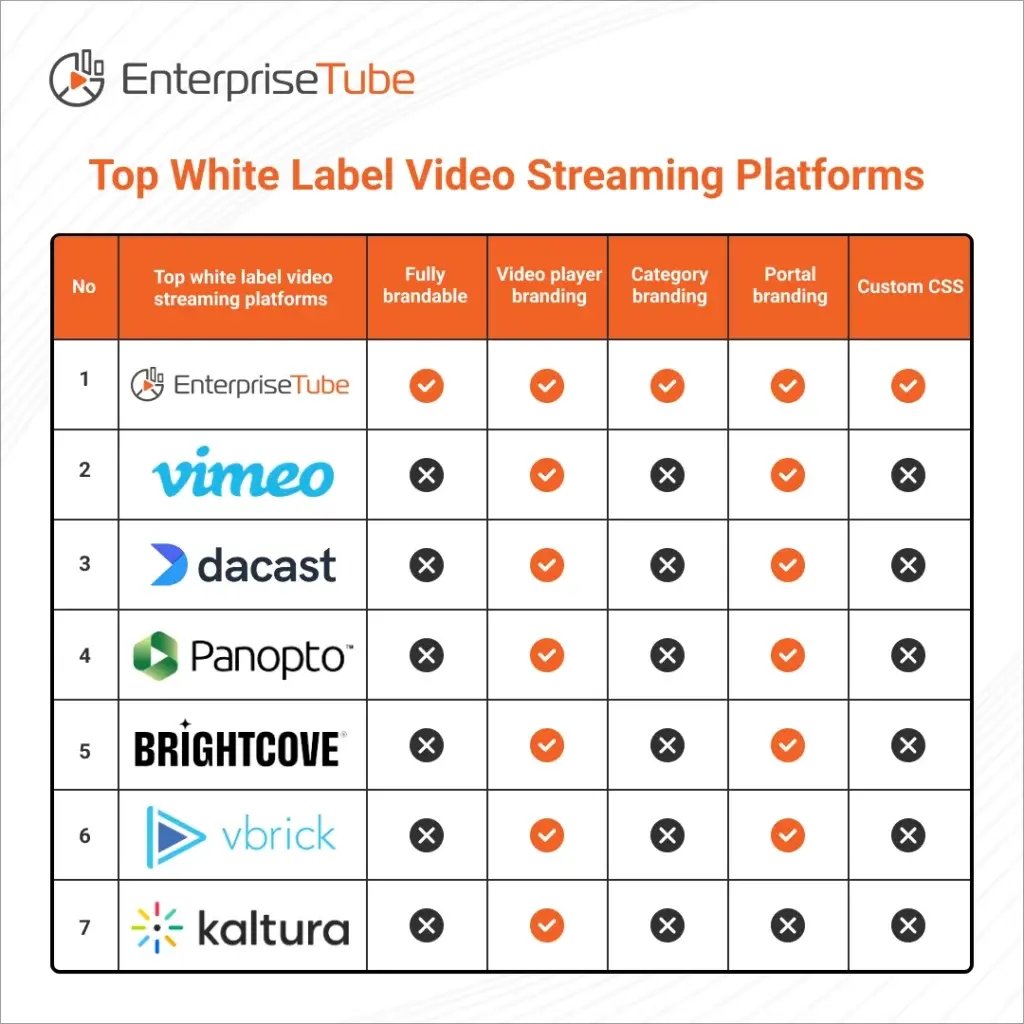
Choosing the right white-label streaming platform depends on your specific business goals and needs. Some may prioritize extensive branding and customization options, while others might value advanced features like analytics or robust content management systems along with branding.
Regardless of priorities, we compared leading white label video streaming platform options and white label VOD platform capabilities across branding depth, security, analytics, streaming quality, and content management.
1) EnterpriseTube
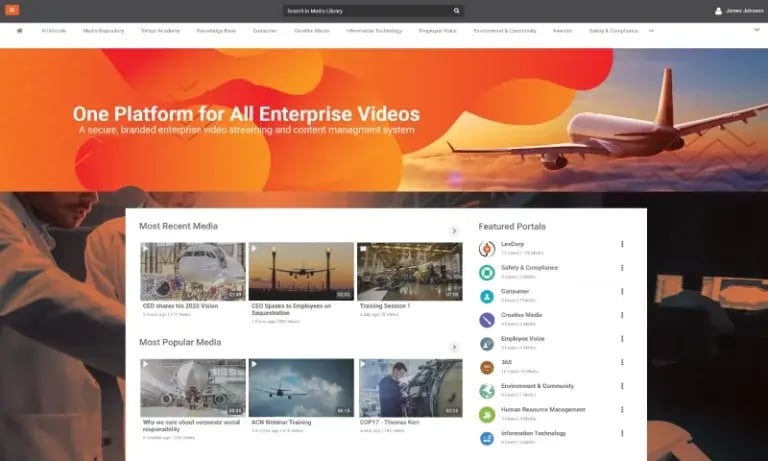
Recognized by Gartner, EnterpriseTube is a comprehensive white label video platform and white label video on demand platform in one—combining advanced branding with enterprise-grade streaming and management. It offers a powerful combination of advanced branding and video streaming capabilities within a single platform. Businesses seeking extensive customization freedom will find EnterpriseTube particularly appealing.
- Logo customization
- Custom domain
- Custom language for each user with 256+ language options
- Navigation menu editing
- Icon color customization
- Custom background/header
- Thesaurus
- Custom player templates
- Theme customization
- Extensive styling using CSS
With all these customization options, EnterpriseTube stands out as a highly customizable white-label platform that lets businesses completely rebrand their video portal to the extent that they become a part of their brand.
However, it is important to remember that EnterpriseTube is not just limited to white label video streaming. Instead, it is a comprehensive enterprise video streaming platform. EnterpriseTube allows users to stream globally without having buffer and bandwidth issues by using adaptive bitrate streaming, content delivery networks, and various streaming protocols.
Pros
- Scalable live streaming with support for eCDN, automatic transcoding, and adaptive bitrate streaming
- On-demand video streaming on any device in over 255 file formats
- Audience interaction through quizzes, forms, handouts, and surveys
- Granular analytics such as geographical heat maps, device usage, engagement metrics, content interaction, performance analytics, and more
- Security features like role-based access control, AES-256 encryption, SSO integration, MFA, password protection, automatic login timeout, etc
- Access controls for video content using role-based access control, category access rights, and users and groups
- Automatic transcription in 40+ languages, translation in 50+ languages, and closed captioning
- Compatibility for a wide range of devices using the HTML5 video player
Cons
- One-on-one chat is not available at the moment. (However, general live chat is supported)

2) VPlayed
VPlayed is a white-label streaming platform that caters specifically to enterprises and content creators who want complete control over their content and revenue. This platform provides complete branding freedom, from overlays to logos, and domain names to player designs, ensuring 100% brand consistency throughout.
VPlayed is a good choice for enterprises that are looking for a lifetime ownership model. This approach is especially ideal for enterprises looking to maximize their return on investment (ROI) while maintaining control over their platform.
The platform also supports seamless migration from legacy systems or competitors to its infrastructure, without any downtime or data loss.
Key Features
- Scalable, Custom solution
- Lifetime platform ownership
- Faster Time-to-Market
- 200+ integrations
- Endless customizations
- HTML5 video player
Pros
- In-depth Analytics that turn raw data into predictive decisions
- Adaptive Bitrate Streaming (ABR) for smart, buffer-free streaming.
- Multi-lingual support for a global reach
- Cross-Platform Compatibility to mitigate compatibility headaches
Cons
- Real-time collaborative editing features are not available. (However, standard video upload and management tools are fully functional)
3) Vimeo
-jpg-1.jpeg?width=1024&height=615&name=Vimeo-Home-Page-Blog-Image-1-1024x615%20(1)-jpg-1.jpeg)
After it acquired Livestream, Vimeo has started offering live streaming in addition to its existing capabilities for on-demand streaming, video management, and secure hosting.
Vimeo is a good choice if you are looking for a video streaming option with decent capabilities. Vimeo's offering allows users to get started quickly with live and on-demand streaming. In addition, users can integrate interactive elements like polls, chats, and links into their Vimeo videos.
Vimeo also supports customization for brands and users. However, it is limited to changing the color and logo and customizing the video player. Thus, it is not suitable as a comprehensive white-label live-streaming platform.
Key Features
- Seamless live streaming with ABR and back-up streams
- Live interactivity
- Video editing
- Social platforms integrations
- White-label HTML5 video player
Pros
- Automatic transcription for English, Spanish, French, German, and Portuguese.
- Ability to share videos on social media.
- High-quality video streaming with low latency and adaptive bit rate streaming.
Cons
- Limited branding options. Users cannot add custom CSS, brand categories, custom domains, etc.
- Vimeo is banned in some countries (China, Cuba, Thailand, and a few more).
4) Dacast
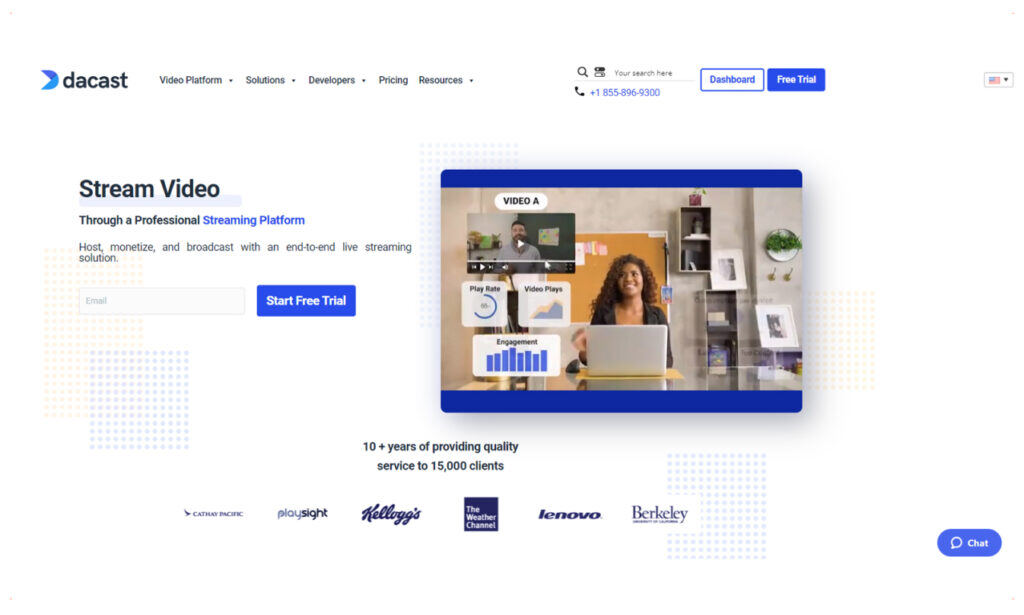
Among the cloud-based video streaming solutions, Dacast is a well-known player. It provides comprehensive streaming and hosting features.
Dacast provides decent live-streaming capabilities with branding options. The HTML5 video player in the platform allows organizations to rebrand the video portal and align it according to their brand. However, there are a few options for customizing the video portal.
Similar to many other video streaming platforms, Dacast provides certain security capabilities like AES encryption, password protection, tokenized URLs, geo-restrictions, and much more.
Key Features
- ABR and multi-bitrate streaming via cloud video transcoding
- Live streaming analytics for locations, viewers, audience engagement, and more
- Live stream embedding
- Secure video sharing
- Ad-free streaming
Pros
- Live video streaming with no content restrictions
- Real-time analytics for video streaming
- Social media integration for live stream sharing
Cons
- Branding is limited to video players, and there are no detailed options for video portals or category branding
- No custom CSS capability
5) Panopto
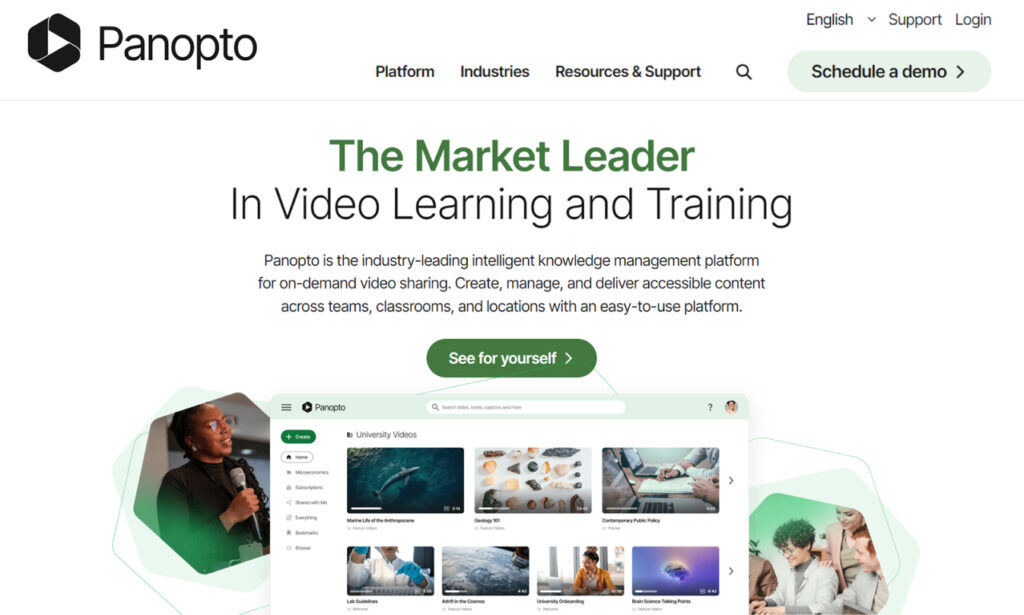
Panopto is a video-on-demand and live-streaming platform focused more on the education sector. It has versatile branding options along with a variety of live-streaming events. Users can also record their live streams and use them as video on demand as soon as the stream ends.
It has extensive logo branding options, which allow users to place logos in various places in their portal and video. It even allows users to add a link to the logo, making it clickable and directing to another page.
Key Features
- Site branding options
- Live streaming recording
- Mobile devices live streaming
- Secure video streaming
- Interactive live elements like live chats and quizzes
Pros
- Live stream on mobile devices
- Analyze real-time live streaming analytics
- Turn live streams into video-on-demand
- Extensive options to brand the logo in the video portal
Cons
- Branding is limited to logos, limited options to rebrand the video portal, and no custom CSS
- SEO-optimization capabilities are limited
6) Brightcove

Another white-label live streaming platform is Brightcove, which offers scalable live streaming and versatile branding options. Brightcove is currently divided into multiple products and solutions, which might make it sound flexible, but it can also be a bit confusing.
In addition, users can use Brightcove's cloud-based encoding platform "Zencoder" for efficient transcoding and content delivery to larger audiences, along with live interactivity.
Key Features
- Interactive live streaming
- Vast integration capabilities
- Multilingual portal
- Extensive branding
- Video on demand
Pros
- Extensive branding includes completely changing the portal, including branding logos, icons, theme colors, and more.
- Businesses can select their desired portal language out of 40+ options
- Social sharing options
Cons
- Only deployable as SaaS
- Limited user management and access control
7) Kaltura
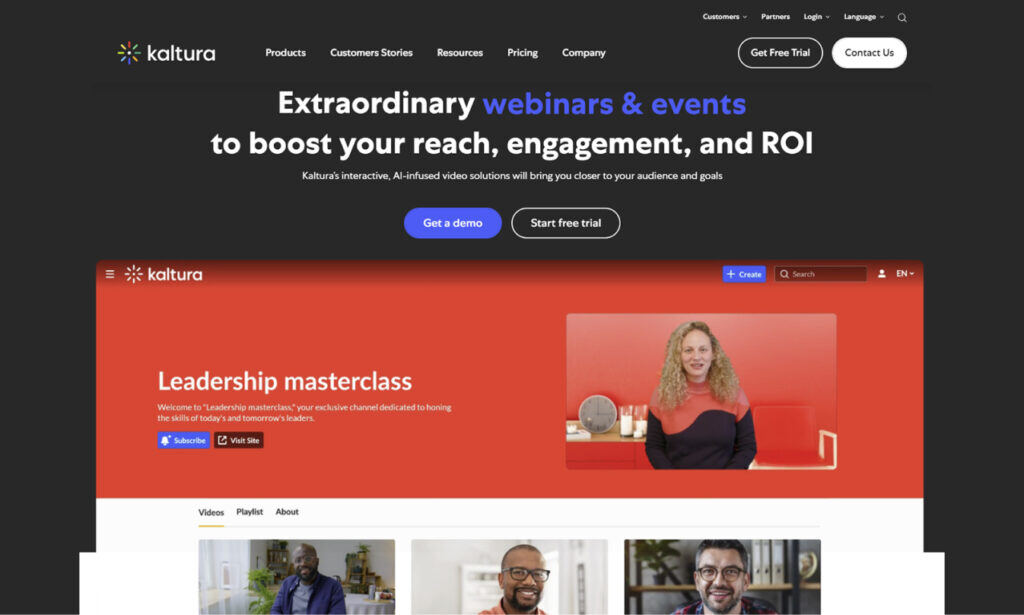
Kaltura is well-known for its video hosting and streaming capabilities. The platform offers a range of video-related products and services, like Kaltura Management Console (KMC), for ingesting, managing, publishing, and distributing media and educational videos.
It also offers branding options to brand the video player by creating a new template or choosing from the existing ones.
Key Features
- Player customization
- Adaptive bitrate streaming
- Content search capabilities
- Media Analytics
- CDN and multicast-based streaming
Pros
- Seamless search for video content using tags, captions, media, and categories
- Cloud transcoding for high-quality adaptive bitrate streaming
- Live streaming recording for video-on-demand content
Cons
- Customization is limited only to video players. It cannot be implemented on video portals or categories.
- Users sometimes face issues with their portal
Why EnterpriseTube Is the Best White Label Live Streaming Platform
EnterpriseTube is an all-in-one enterprise video platform. From live streaming to sharing video on demand, it takes care of all enterprise video content needs. Using EnterpriseTube, organizations can leverage video content for different use cases like training and development, corporate communication, video marketing, virtual events, and so on.
From start to finish, EnterpriseTube is fully customizable to meet extensive branding requirements. Organizations can change the logo, font, colors, backgrounds, and thumbnails, customize their video player, choose their custom domain, and go even further with custom CSS styling.
But that's not all. Businesses can enjoy an array of features, which include state-of-the-art video content capabilities and security features like the following:
- Format agnostic player (255+ formats)
- Audit logs
- Role-based access control and category access rights
- Multi-tenancy
- AI-based transcription (more than 40 languages), translation (more than 50 languages), and closed captioning.
- In-depth details of user engagement, audience analytics, interactivity, heatmaps, and various other useful metrics
- A vast range of integrations with video conferencing, content management, and SSO tools
- Flexible deployment options (cloud, on-premises, or use a hybrid model)

Your organization can use many more features and capabilities to ensure a smooth and secure video streaming and sharing experience.
Choose the Best White Label Video Streaming Platform (Live + VOD)
Choosing the right white label video streaming platform—and a capable white label video on demand platform—can be overwhelming when options look similar. Remember, the ideal platform depends on your unique needs. Are extensive branding options more valuable, or are advanced analytics and robust content management systems a higher priority?
Fortunately, this guide explored the key features and considerations when choosing a white-label platform, comparing some leading solutions and highlighting their strengths and limitations.
As we have compared the best white label video streaming solutions, you can easily select the correct one based on crucial factors like how much branding can be done, content sharing and storing capabilities, and platform security.
You can explore the available platforms, leverage their customization features, and captivate your audience with a seamless and branded live video experience. But if you want a comprehensive white label platform to get started with, then EnterpriseTube is your best bet.
Ready to get started? Try EnterpriseTube free for 7 days, or contact us to learn more.
People Also Ask
What is a white-label video streaming platform?
A white-label video streaming platform is a fully brandable solution that lets organizations host, stream, and manage video under their own identity, with custom logos, colors, fonts, domains, and a player that matches brand guidelines without third-party branding.
Why choose a white label live streaming platform instead of YouTube or Vimeo?
A white label live streaming platform gives complete branding control, removes third-party ads and logos, and adds enterprise features like granular access control, SSO, DRM, audit logs, and custom domains and capabilities that general platforms typically restrict.
How does a white label video platform improve brand consistency?
A white label video platform extends your visual system across the portal and player, aligning logos, color palettes, typography, domains, and UI states so every live stream and VOD session reinforces the same brand experience across touchpoints.
Which features matter most when selecting a white-label video streaming platform?
Look for deep customization (CSS, player templates, custom domains), secure delivery (encryption, tokenized links, RBAC, DRM), scalable streaming (ABR, CDN), rich analytics, integrations (LMS, CRM, SSO), and strong content management for VOD libraries.
Can a white label live streaming platform handle both live and on-demand video?
Yes, a white label live streaming platform typically supports real-time events with ABR and recording, then publishes the session as VOD in the same branded portal with access policies, interactivity, captions, and searchable transcripts.
How does a white-label video streaming platform help with security and compliance?
A white-label video streaming platform can enforce authentication, authorization, and role-based permissions, add AES encryption and DRM, restrict by domain/IP/geo, log every action for audits, and support frameworks like GDPR or HIPAA, depending on deployment.
Can I use my own domain and SSL with a white label video platform?
Yes, most white label video platforms support custom domains and managed SSL/TLS, so viewers see your branded URL and secure padlock during live and on-demand playback, strengthening trust and SEO.
How do analytics work in a white-label video streaming platform?
White-label video streaming platforms offer viewer-level and content analytics such as watch time, drop-off points, heatmaps, device/location trends, interactivity results, and conversion events, with options to export or sync to tools like GA or BI suites.
Does a white label VOD platform integrate with existing tools?
A white label VOD platform typically provides APIs, webhooks, and native connectors for SSO, LMS/LXP, CMS, CRM/marketing automation, and conferencing apps, enabling automated publishing, user provisioning, and unified reporting within your current stack.
About the Author

Jump to
.webp)
Best Enterprise Live Streaming Platforms for Businesses (2026 Complete Guide)
Private Video Sharing

No Comments Yet
Let us know what you think