
by Ali Rind, Last updated: July 7, 2026

Vimeo Enterprise does offer HIPAA support, but only under specific and constrained conditions. Healthcare IT buyers evaluating Vimeo for clinical training, patient education, or internal video management need to understand exactly what the platform covers and where it falls short before signing a contract.
This comparison breaks down Vimeo's HIPAA offering against VIDIZMO EnterpriseTube, a platform built from the ground up for regulated environments. The goal is not to disparage Vimeo. It is to give procurement and compliance teams the facts they need for an informed decision.
What Vimeo's HIPAA Offering Actually Covers
Vimeo supports HIPAA-compliant video playback for Enterprise plan customers who sign a Business Associate Agreement (BAA). The BAA is not available on Starter, Standard, or Advanced plans. It requires a specific BAA SKU on the Enterprise order form.
Once the BAA is in place, organizations must follow a 10-step configuration process. This includes disabling comments and third-party integrations, requiring SSO and two-factor authentication, and restricting user access through folder-level permissions.
Vimeo's HIPAA support is designed primarily for one use case: hosting video content that is played back to authorized viewers through an embedded player. It is not designed for clinical training programs, patient communication workflows, or AI-powered content processing.
Specific Vimeo Limitations for Healthcare
Vimeo's HIPAA documentation includes several restrictions that directly affect healthcare organizations. These are not hidden, but they are easy to miss if you only read the marketing page.
AI Tools Are Excluded from the BAA
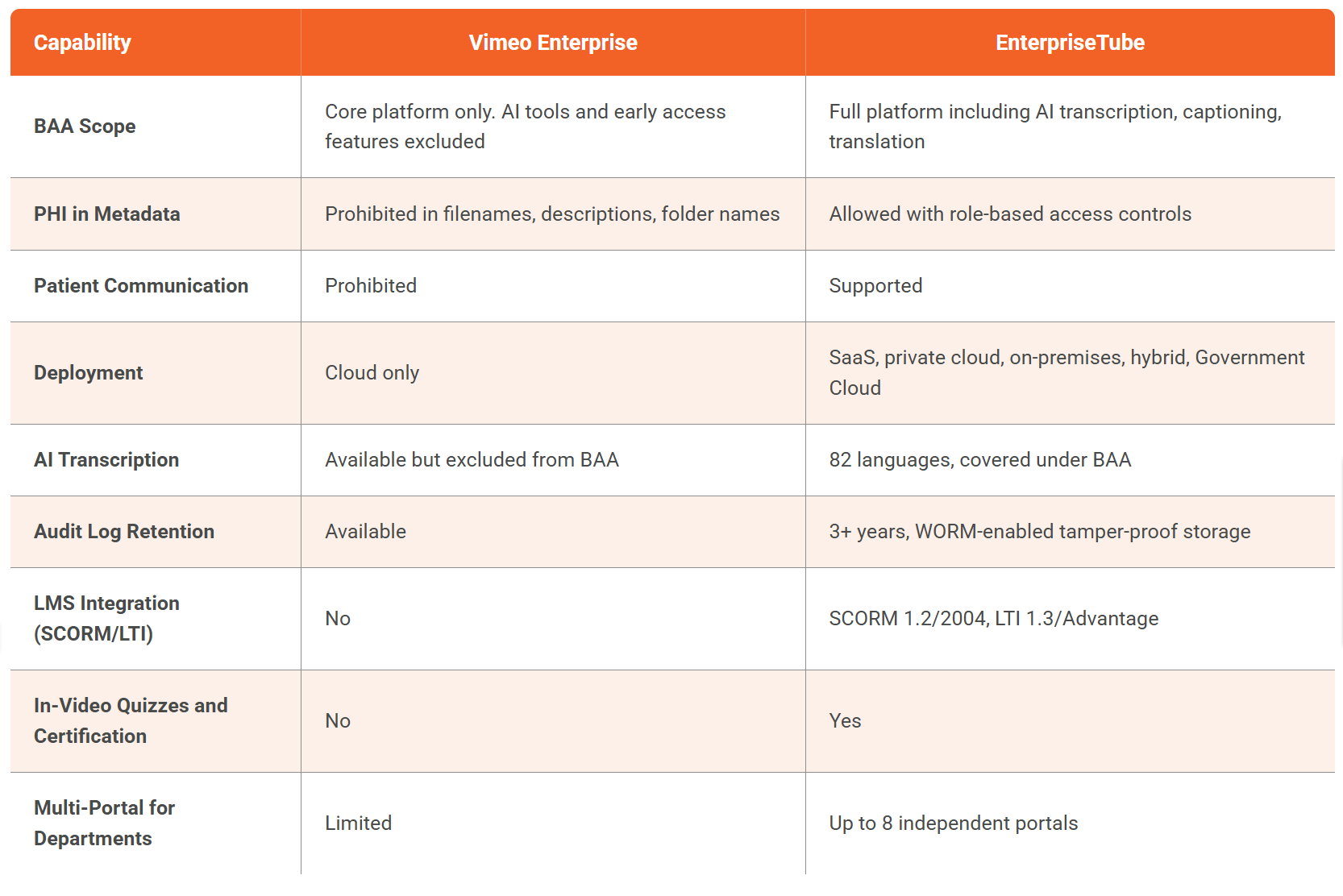
Vimeo's BAA explicitly excludes artificial intelligence tools and early access features. This means AI-powered transcription, captioning, translation, and any other AI feature cannot be used on content containing Protected Health Information (PHI). For clinical training libraries that rely on automated captions for accessibility or searchable transcripts for content discovery, this is a significant limitation.
PHI Is Banned from Filenames and Metadata
Vimeo requires that customers do not upload content that, by itself, contains PHI. This restriction extends beyond video files to filenames, descriptions, custom links, folder names, and user profile data. You cannot name a training video with patient-identifiable information or organize folders by case or patient reference. For large clinical training libraries, this restriction makes content management substantially harder.
No Patient Communication Use Cases
Vimeo explicitly prohibits using the platform to receive communications from patients, plan members, or their families and employers. You also cannot store recordings or summaries of patient communications, even as private videos. If your video program includes patient education delivery, post-discharge instructions, or any patient-facing content, Vimeo's terms do not cover those use cases.
Vimeo Cannot Serve as a System of Record
The platform states that it cannot serve as your system of record for PHI. Organizations must maintain independent backup and recovery procedures. This adds operational overhead and means you need a separate compliant storage layer for your regulated video content.
Cloud-Only Deployment
Vimeo Enterprise is a cloud-only platform. There is no on-premises deployment option and no private cloud tenant. For healthcare organizations that require data to stay within their own network, or those subject to state-level health data residency laws, this limits viability.
Vimeo Enterprise vs. EnterpriseTube
When Vimeo Might Still Work
Vimeo Enterprise can be a reasonable choice for healthcare organizations with limited, clearly defined use cases.
Small organizations with a handful of training videos that do not contain PHI may find Vimeo adequate. If your content is limited to general policy training, safety orientations, or non-clinical onboarding, the HIPAA constraints are less likely to cause problems.
Non-clinical departments such as HR, marketing, or administration that produce video content without PHI can use Vimeo Enterprise under standard security configurations without needing the full HIPAA setup.
Supplementary use alongside a primary compliant platform is another option. Some organizations use Vimeo for external-facing, non-PHI content while hosting clinical content on a purpose-built platform.
When You Need a Purpose-Built Platform
The limitations in Vimeo's HIPAA offering become material when your video program involves any of the following.
Clinical training at scale. Large health systems with hundreds of training videos, multiple departments, and thousands of clinical staff need a platform with proper content organization (including PHI in metadata), role-based access at a granular level, and LMS integration. Vimeo's restrictions on metadata and lack of SCORM/LTI make this difficult.
AI-powered accessibility and search. Automated transcription and captioning are essential for clinical training programs that serve diverse, multilingual staff. If the BAA does not cover AI tools, you cannot use them on regulated content. EnterpriseTube covers AI transcription across 82 languages under the same BAA.
Patient education or patient-facing content. Any workflow that involves delivering video content to patients, families, or plan members is explicitly prohibited under Vimeo's HIPAA terms.
On-premises or data residency requirements. Academic medical centers, Veterans Affairs hospitals, and organizations subject to state health data laws often require on-premises deployment or guaranteed US data residency. Vimeo offers neither.
Long-term audit and compliance documentation. HIPAA requires documentation retention for at least six years. Platforms with tamper-proof, WORM-enabled audit logs and configurable retention policies reduce the compliance burden significantly.
EnterpriseTube Differentiators for Healthcare
VIDIZMO EnterpriseTube supports HIPAA-compliant deployments with architecture designed for regulated use from the start, not retrofitted as a configuration checklist.
Full BAA coverage includes the core platform and all AI-powered features. There are no carve-outs for transcription, captioning, translation, or search.
Deployment flexibility spans SaaS with dedicated tenants, private cloud, on-premises, hybrid, and Azure Government Cloud. Data stays where your security policy requires it.
Native training tools include in-video quizzes, automated certification, SCORM 1.2 and 2004, LTI 1.3/Advantage, and learning plan management. Clinical L&D teams do not need a separate LMS for video-based training.
Proven healthcare deployments include UMass Chan Medical School (HIPAA, SOC 2, FIPS, NIST compliance with departmental segregation for 6,000 users), Memorial Sloan Kettering Cancer Center (multi-portal for patients, public, and Board of Trustees), and El Dorado Community Health Centers (HIPAA-compliant behavioral health video with automated retention and secure sharing).
Security infrastructure includes AES-256 encryption, zero-standing-access for VIDIZMO staff, quarterly penetration testing, and AI that does not train on customer data by default.
Book a personalized EnterpriseTube demo to see how the platform handles your specific HIPAA requirements.

Key Takeaways
-
Vimeo Enterprise supports HIPAA, but with significant constraints: AI tools are excluded from the BAA, PHI is banned from metadata, patient communication use cases are prohibited, and deployment is cloud-only.
-
EnterpriseTube covers AI features under the same BAA, supports on-premises and private cloud deployment, and includes native LMS capabilities.
-
For small-scale, non-clinical video hosting, Vimeo can work. For clinical training programs at scale, patient-facing content, or organizations with data residency requirements, a purpose-built platform is the safer choice.
-
Always read the full BAA, not just the marketing page. The exclusions matter more than the inclusions.
Making the Right HIPAA Video Platform Decision
The right platform depends on the scope and sensitivity of your video program. Vimeo Enterprise is a capable video host with legitimate HIPAA support for constrained use cases. But the exclusions around AI tools, metadata, patient communication, and deployment flexibility create real gaps for healthcare organizations with complex clinical training needs.
If your video content touches patient environments, requires AI-powered accessibility, or must stay on-premises, evaluate platforms built for that reality from day one.
About the Author

Jump to

Vidyard Alternatives for Enterprise Video in 2026

Brightcove Alternatives in 2026: What Enterprise Teams Are Choosing After the Acquisition


No Comments Yet
Let us know what you think